What Actually Makes a Great News App in India in 2026?
India's mobile news landscape is crowded. Inshorts, Google News, Dailyhunt, NDTV, Times of India, NewsX, Republic, and a long tail of regional apps all compete for the same daily reader. Most of them solve the wrong problem — they help you read more news faster, but not better. The country's media reality is that a single political story is reported by 50+ outlets simultaneously, each filtering it through their owners, advertisers, and political alignments. Reading any one source — even a respected one — gives you one slice of one story.
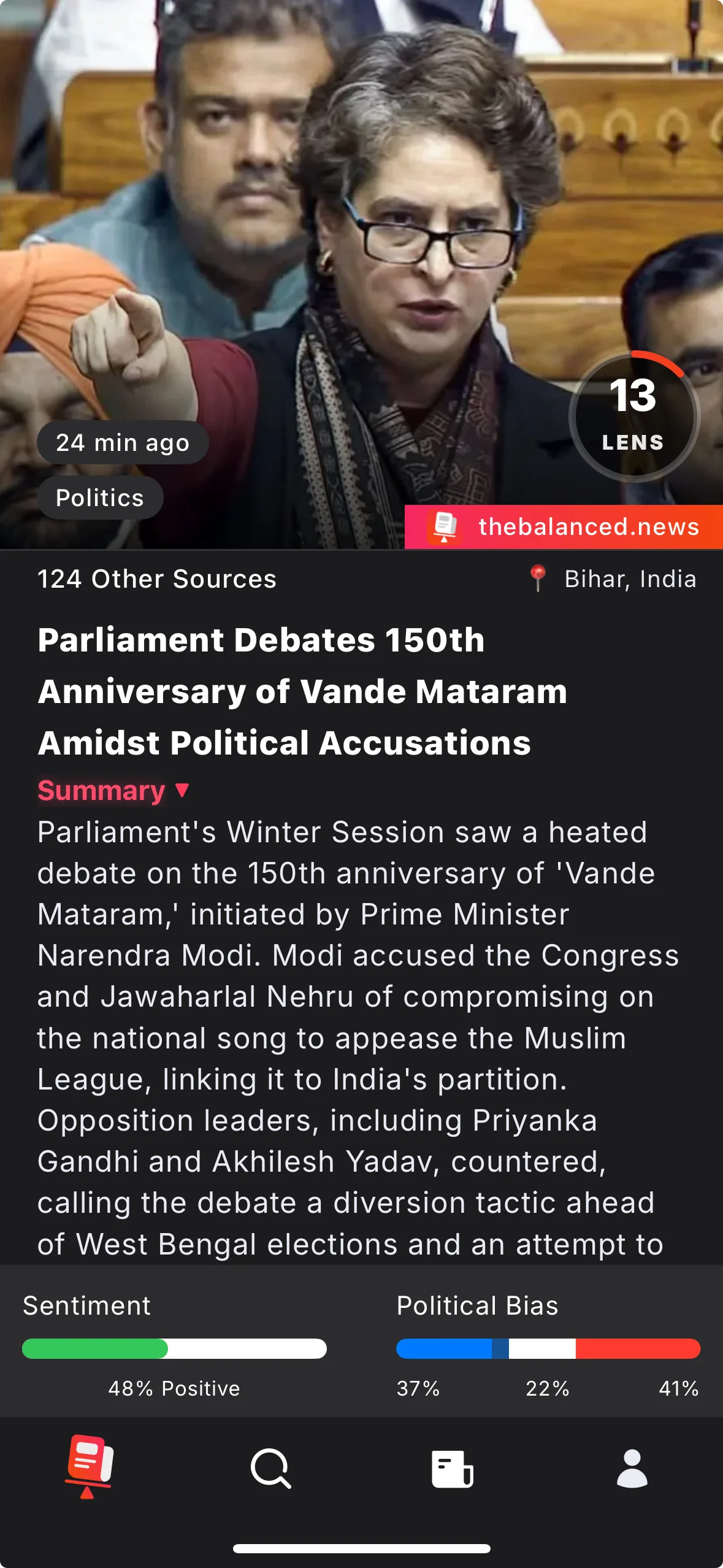
A genuinely useful news app for an Indian reader has to do four things: aggregate broadly enough to capture the full spectrum of coverage, surface the bias and framing differences between outlets without taking sides, identify the stories that matter but are being underplayed, and stay independent of the publishers it's analysing. Most existing apps fail at least one of these. Aggregators like Google News and Inshorts cover the breadth but show you a single headline per story, so you never see how Republic, NDTV, and The Hindu framed the same event differently. Single-publisher apps (Times of India, Hindu, NDTV, Indian Express) are convenient but by definition give you one editorial line. The Balanced News was built specifically to address this gap: aggregation plus per-source bias and sentiment scoring on every story, with a Lens Score that flags coverage gaps.
How We Evaluate News Apps for Indian Readers
Our comparison criteria are deliberately practical, not feature-list marketing. We weight an app on five axes: source breadth (how many outlets feed the headline mix), perspective transparency(whether the app shows you which outlet ran which version of the story), bias and framing detection (does it explicitly analyse political lean and sentiment, or treat all coverage as neutral), regional and language reach (how well it covers Indian-language press and state-level stories), and independence(whether the app is owned by or financially dependent on the publishers it's surfacing).
Source breadth and language reach are the easy parts — most major Indian news apps cover the top 20 English-language outlets and 5–10 regional dailies. The hard part, and the one that almost no app does well, is perspective transparency. When the same story is reported as "government takes decisive action" by one outlet and "centre bypasses consultation" by another, a reader needs to see both framings side by side, not just one randomly chosen headline. That's the gap our app was built to close, and it's why we publish per-source bias breakdowns on every story rather than a single "balanced" summary.
Major News Apps in India — Honest Strengths and Weaknesses
A snapshot of the apps Indian readers most commonly install, what each does well, and where each falls short for someone who wants to understand the full picture of a story rather than just consume headlines.
Inshorts
Famous for its 60-word summaries. Excellent for skimming the day's news in five minutes. The format is its strength and its weakness: summaries necessarily flatten framing differences, so two outlets covering the same event with very different angles end up looking identical. Inshorts shows you what happened; it does not show you who said it happened that way or why their wording matters. For fast-scanning brand and entertainment news this works. For political or policy stories, it actively obscures the information you'd need to form an informed view.
Google News
Strong on breadth — pulls from hundreds of Indian outlets including regional sources Western readers wouldn't recognise. Personalises aggressively to your reading history, which is also its problem: the more you read, the more it narrows toward your existing perspective. There's no bias annotation, no "how did the right and the left frame this differently" lens. You can manually click through 5–10 sources for a story and reconstruct the picture, but no busy reader actually does that.
Dailyhunt
Strongest among major apps for regional Indian-language coverage — 14+ languages including Hindi, Marathi, Telugu, Tamil, Bengali, Gujarati, Kannada, Malayalam, Punjabi, Odia. Heavy on sensational and viral content as the engagement strategy; the algorithm rewards what gets clicked, not what informs. Useful as a regional supplement; not a standalone solution if you want analysis-grade coverage.
NDTV / India Today / Times of India / The Hindu apps
All four are competent single-publisher apps with strong push notifications and decent depth on their own beats. Each has a consistent editorial line — that's not a flaw, it's how publishing works. The question is whether reading from one of them gives you a full picture. It doesn't. NDTV and The Hindu lean centre-left; Republic and Times Now lean centre-right; Times of India and India Today are closer to centre. None of them tell you that themselves, which is precisely the problem.
The Balanced News
Where we sit: aggregator first (50+ Indian sources across the political spectrum), with explicit per-source bias and sentiment analysis on every story. The Lens Score flags stories where coverage and public interest diverge — typically the accountability and policy stories most outlets underplay. Translation in seven Indian languages. Free, ad-supported but not advertorial. We don't claim to be neutral — neutral is a marketing word — we claim to surface all sides so you can decide what's accurate.
Why Bias Detection Matters More in India Than Almost Anywhere Else
Indian news media is more concentrated and more politically aligned than most readers realise. A handful of corporate groups own most of the top-15 English-language outlets; many regional language papers are directly tied to political parties or industrial families. Add the dependence on government advertising — a substantial revenue line for many newsrooms — and the alignment between what a paper covers, how it covers it, and the interests of its owners and patrons becomes structural rather than incidental.
That's not a unique pathology, but the scale matters. A reader in India who depends on one source — even one they've trusted for years — is statistically getting one filtered version of national events. The remedy isn't to read more articles; it's to read across the spectrum and see what gets emphasised, omitted, or framed differently. Bias detection, done honestly, is just an automation of what an informed reader does manually: comparing how five outlets covered the same story before forming a view. That's the job a news app should do.
What to Look for When Choosing a News App in 2026
A short checklist that holds up across the apps available in India today:
- Multiple sources per story, not just one headline.Aggregators that show you a single headline are hiding the framing differences between outlets.
- Visible source attribution on every claim. If the app summarises stories without citing per-source headlines, you can't audit what's been left out.
- Independence from the publishers. Apps owned by or backed by the publishers they aggregate have an obvious conflict with showing you when those publishers slant stories.
- Explicit bias and sentiment analysis. Nobody is "neutral" — pretending to be is the warning sign. Apps that name and quantify lean are more honest than apps that don't.
- Regional and language coverage. Half of India's major news happens outside English-language Delhi/Mumbai newsrooms. An English-only feed misses systematic structural coverage.
- No clickbait optimisation. An app that ranks stories by what's likely to be clicked is by definition surfacing outrage and entertainment, not importance.
- A clear editorial standards page and corrections policy. Apps that won't tell you how they handle errors don't handle errors. We publish ours at editorial standards and corrections policy.
More Questions About Indian News Apps
Which news app is best for following Indian elections?
An election cycle is the worst possible time to depend on any single outlet — every source has a stake in the narrative, and framing differences between Republic, NDTV, The Hindu, India Today, and ABP are at their starkest. Use an app that shows you all of them on the same story and analyses the bias, then check the EC's own data for results and turnout. The Balanced News is built for exactly this — the political category and Lens Score help surface the accountability stories that get buried under campaign coverage.
What's the difference between a news aggregator and a news app?
A news app from a publisher (NDTV, TOI, Hindu) shows you that publisher's content. A news aggregator (Google News, Inshorts, Dailyhunt, The Balanced News) pulls from many publishers. The important second-order distinction is what aggregators do with the multiple sources: most show you one chosen headline per story, a few (we're one) show you all of them with framing analysis.
Are paid news apps better than free ones in India?
Not automatically. Paid subscriptions remove ads and can fund long-form reporting (the Hindu, Mint, Indian Express paid tiers are good examples). But payment doesn't make a single source less ideologically aligned. The right question is whether the app's economics align with showing you accurate information — independence and ad-policy matter more than the price tag.
Which news app has the best fact-checking?
No general-purpose Indian news app does verification well at the article level — fact-checking is mostly handled by dedicated orgs like Alt News, Boom Live, and The Quint's WebQoof. Use those alongside whatever aggregator you read. The Balanced News shows you when claims diverge between outlets, which is a useful signal that something is contested even if we don't adjudicate which side is right.
Best news app for regional Indian news?
Dailyhunt has the broadest regional-language footprint by sheer count. Inshorts covers Hindi, Tamil, Telugu, Bengali, Marathi, Gujarati. The Balanced News currently supports translation into seven Indian languages on every story (Hindi, Marathi, Gujarati, Tamil, Telugu, Bengali, Punjabi), with the bias and sentiment analysis preserved across languages. For a state-level beat — Tamil Nadu politics, Maharashtra civic news, Kerala health policy — you'll get more depth from a regional outlet's own app, but you'll lose the cross-source perspective.
How can I avoid news bias if I can't find a fully unbiased app?
You can't. Every app, every outlet, every editor has a perspective; "fully unbiased" is marketing language. What you can do is read across the spectrum (left, centre, right; English and at least one regional language; mainstream and independent), notice what gets covered vs ignored, and triangulate. An app that surfaces the bias for you reduces the work — that's the entire point of how we built ours. See our guide to identifying bias for the manual version.
Is The Balanced News available offline?
Articles you've already loaded are cached for offline reading. Initial fetch and bias analysis require a connection. The web app at thebalanced.news works in any modern browser — useful when you want a desktop read or want to share a link with full source comparison.
How does The Balanced News make money?
The mobile app shows display ads and we plan a paid tier for advanced features. We don't take money from publishers we aggregate, we don't run sponsored stories, and we don't sell reader data. Our economics are described in full on the about page. Independence from the news outlets is the point — without it, an app analysing publisher bias has an obvious conflict.
The Short Answer
If you want one app that aggregates Indian news, shows you how different outlets framed the same story, surfaces the underreported stories that matter, and supports seven Indian languages — install The Balanced News. It's free, it's available on iOS and Android, and it's the only major Indian news app built around perspective transparency rather than headline aggregation.
For a deeper look at how the bias and Lens Score systems work, read how bias detection works and what is Lens Score. If you'd rather read on the web, every story is also at thebalanced.news.