4 hours agoEducation
19LENS
2 SourcesIndia
 thebalanced.news
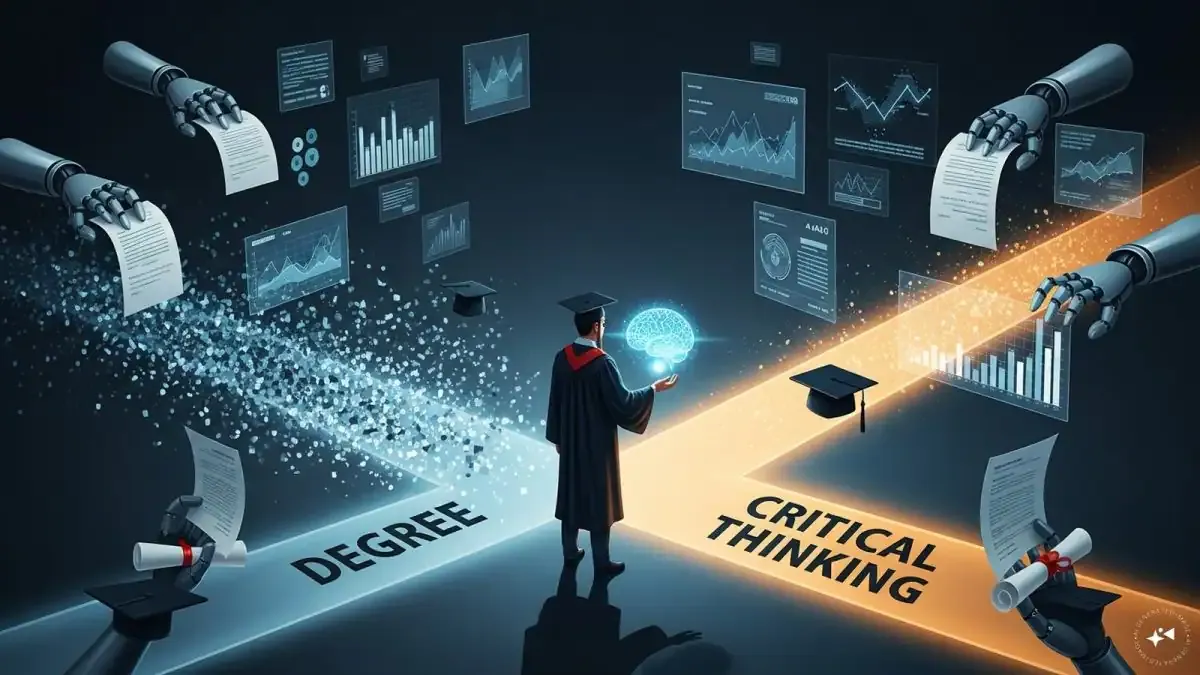
Education Shifts Toward Interdisciplinary Skills and Applied Portfolios Amid AI Advances
Recent analyses highlight a shift in education as traditional degrees become less reliable indicators of job readiness, especially with AI making task execution easier. Employers increasingly value interdisciplinary skills and portfolios demonstrating applied capabilities over isolated academic knowledge. This evolution reflects the need for graduates who can integrate diverse domains and solve complex problems, prompting calls for education systems to redesign curricula and assessment methods to emphasize reasoning, creativity, and real-world outcomes.
Political Bias
0%100%0%
Sentiment
70%
AI Analysis
Political bias across 2 sources
● Left 0%● Center 100%● Right 0%
The articles present a largely neutral perspective focused on education and labor market trends without explicit political framing. They emphasize systemic changes in education and employer expectations, reflecting viewpoints from industry analysts and education experts. The coverage does not align with partisan positions but rather discusses broad societal and economic shifts affecting education policy and workforce development.
Sentiment — Positive (70/100)
The tone across the articles is analytical and forward-looking, acknowledging challenges posed by AI and traditional education models while highlighting opportunities for innovation in teaching and assessment. The sentiment is generally constructive, emphasizing adaptation and evolution rather than crisis or decline, with a focus on positive potential for interdisciplinary learning and capability demonstration.
How 2 sources covered this story
Each source's own headline, political lean, and sentiment — so you can see framing differences at a glance.
| Source | Their headline | Bias | Sentiment |
|---|---|---|---|
| firstpost | Beyond the degree: What education must become in the age of AI | Center | Neutral |
| economictimes | Is the degree dead? Why India's next innovation wave will be driven by interdisciplinary portfolios | Center | Positive |
Coverage timeline
economictimes broke this story on 17 Apr, 01:23 pm. Other outlets followed.
- 1economictimes17 Apr, 01:23 pmIs the degree dead? Why India's next innovation wave will be driven by interdisciplinary portfolios
- 2firstpost18 Apr, 03:46 amBeyond the degree: What education must become in the age of AI
Lens Score breakdown
19/100
Public interest0/100
Coverage gap100%
Well-covered story — coverage matches public importance.
Story context
- Category
- Education
- Location
- India
- Sources analysed
- 2
- Last analysed
- 18 Apr 2026
- Key entities
- Artificial intelligenceCurriculumLabour economicsParadoxComputer scientistSpreadsheetAlgorithmFinanceSoftwareSocial normIndependence (probability theory)Financial forecast
Related Coverage
Select a news story to see related coverage from other media outlets.