Agni MIRV Test Explained: What India Actually Achieved
TL;DR
India tested an advanced Agni missile with MIRV and hypersonic glide vehicle technology on May 8, 2026, becoming the only country to combine both on an ICBM-class platform in a single test. The achievement is real, but the "game-changer" framing in Indian media papers over serious strategic questions: whether MIRVs contradict India's stated minimum deterrence doctrine, and whether they make South Asia safer or more dangerous.
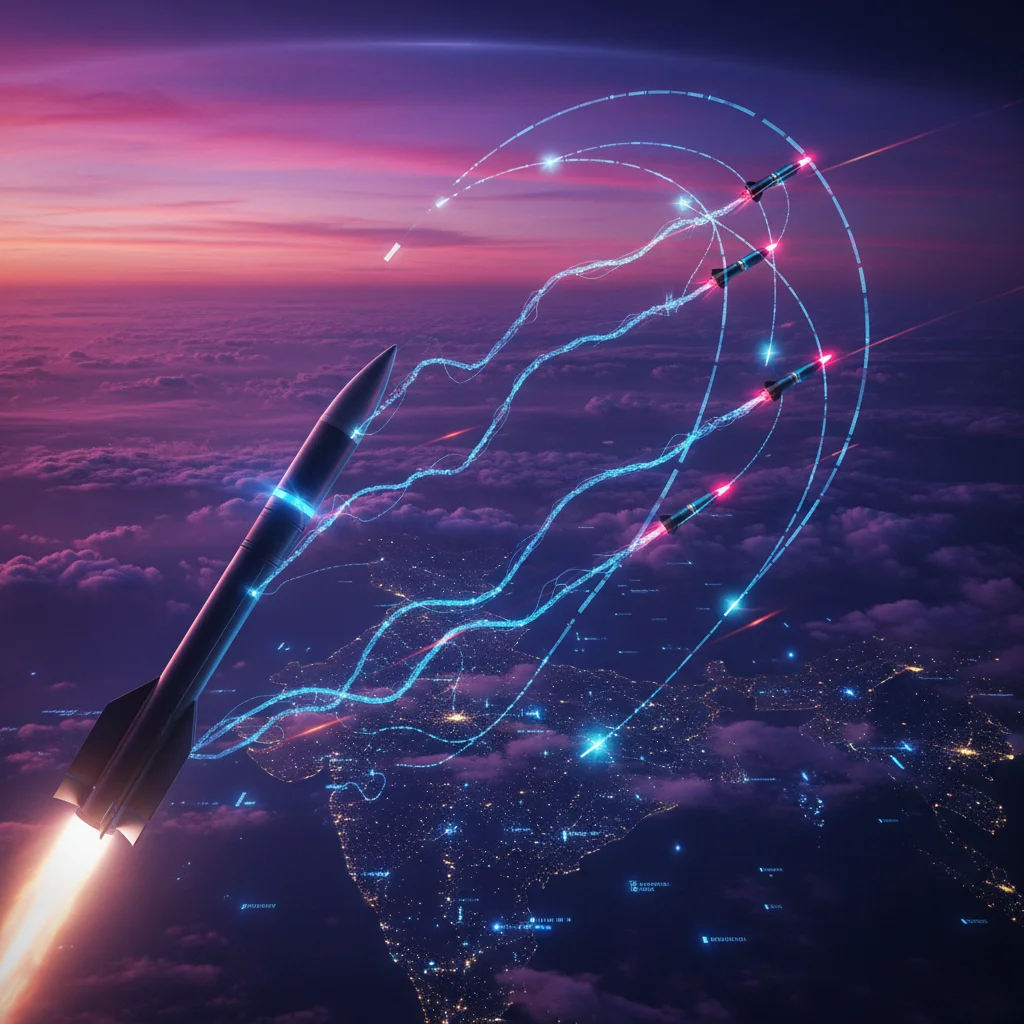
On the evening of May 8, a missile launched from Dr APJ Abdul Kalam Island off Odisha's coast and sent multiple warheads streaking across the Indian Ocean toward separate targets distributed over a vast geographical area. The Defence Ministry confirmed the next day that it was "an Advanced Agni missile with MIRV (Multiple Independently Targeted Re-Entry Vehicle) system." Defence Minister Rajnath Singh called it "an incredible capability" against "growing threat perceptions."
Within hours, Indian newsrooms were in overdrive. Headlines ranged from "India's firepower just got more dangerous" to "Big Worry For Pakistan, China." The BJP posted on social media that "Agni-6, with a strike range of over 10,000 kilometres and MIRV technology, is ready to make history." The Defence Ministry, notably, did not name the missile variant.
So what actually happened? What did India test, what does it mean, and what are Indian media outlets not telling you?
What is MIRV, in plain English?
A traditional ballistic missile carries one warhead. A MIRV-equipped missile carries several, and after the missile's propulsion stages burn out, the warheads separate and fly toward different targets on independent paths. Think of it as one delivery truck dropping off packages at multiple addresses, except each package is a nuclear weapon.
The Center for Arms Control and Non-Proliferation defines MIRVs as payloads "containing several warheads, each capable of being aimed to hit a different target." Some systems can strike targets as far as 1,500 kilometres apart from a single launch.
The technology is old. The United States deployed the first MIRVed ICBM in 1970, and the Soviet Union followed by the late 1970s. Today, six countries operate proven MIRV systems: the US, Russia, the UK, France, China, and now India. Pakistan tested a MIRVed missile in 2017 but hasn't demonstrated operational capability since.
What makes MIRV strategically significant isn't just hitting more targets. It also overwhelms missile defences. An adversary's interceptor system must now track and destroy multiple warheads from a single missile instead of one. During the Cold War, the US developed MIRV specifically to counter Soviet missile defences around Moscow.
What India actually tested on May 8
Here is where Indian media coverage gets blurry.
The PIB press release was carefully worded: "Advanced Agni missile with MIRV system." No variant number. No range figure. No mention of how many warheads it carried. The ministry said only that "multiple payloads" were "targeted to different targets spatially distributed over a large geographical area in Indian Ocean Region," and that "all mission objectives were met."
PTI, citing unnamed defence sources, identified the missile as the nuclear-capable Agni-5, India's longest-range ballistic missile with a stated range of around 5,000 km. But several outlets immediately jumped to calling it the "Agni-6 ICBM" with a 12,000 km range. The analytical reality sits somewhere in between.
Defence analysts at India Sentinels offered a more careful assessment. The Notice to Airmen (NOTAM) issued for the test cordoned off a 3,560 km corridor over the Bay of Bengal. That number doesn't represent maximum range; it is a safety corridor for aviation and shipping. India routinely uses "lofted trajectories," steep-angle firing profiles, to test long-range missiles without overflying foreign territory. The analysis concluded the NOTAM is "entirely consistent with a test of a system whose true design envelope extends to 8,000 to 10,000 kilometres."
This test also introduced something new: a Hypersonic Glide Vehicle (HGV) integrated with the MIRV payload. An HGV is released during descent and manoeuvres at Mach 5 and above, following an unpredictable flight path that makes interception far harder than a standard ballistic re-entry. Combining MIRV and HGV on a single platform is something no other country has publicly demonstrated in a single test.
India's first MIRV test happened in March 2024 under Mission Divyastra, demonstrating a three-to-four warhead capacity. A user validation trial by the Strategic Forces Command followed in August 2025. The May 2026 test represents a qualitative leap: more warheads, longer apparent range, and HGV integration.
The numbers behind the hype
Here is what we know from verified sources.
| Parameter | Detail | Source |
|---|---|---|
| Test date | May 8, 2026 | PIB |
| Location | Dr APJ Abdul Kalam Island, Odisha | PIB |
| NOTAM corridor | 3,560 km over Bay of Bengal | India Sentinels |
| Estimated real range | 8,000-10,000 km (analyst estimate) | India Sentinels |
| Warhead capacity (demonstrated) | 3-4 (Mission Divyastra, 2024) | The Print |
| Warhead capacity (theoretical) | 10-12 | India TV News |
| Launch mass | ~50 tonnes | Wikipedia/Agni-V |
| Development cost | Over $292 million | Wikipedia/Agni-V |
| India's total nuclear warheads | ~180-190 (est. Jan 2025) | SIPRI Yearbook 2025 |
The gap between "demonstrated" and "theoretical" warhead capacity deserves scrutiny. The March 2024 test showed three to four warheads. Claims of ten to twelve come from unnamed sources and represent theoretical maximum payload, not what has been flight-proven. Indian media rarely makes this distinction.
How Indian media covered it
Coverage split along predictable lines.
The triumphalist frame: Most major outlets led with nationalist celebration. Zee News called it India's "most advanced nuclear missile." NewsX went with "Big Worry For Pakistan, China," framing the test primarily as a message to adversaries. Business Today called it a "major breakthrough." Very few of these pieces questioned the strategic implications or mentioned arms control concerns.
The variant inflation: Multiple outlets reported the missile as the "Agni-6 ICBM" with a 12,000 km range, despite the Defence Ministry never naming the variant. The BJP's own social media claim about Agni-6 readiness was treated as confirmation by several newsrooms, blurring the line between political messaging and verified fact.
What was missing: Almost no Indian outlet cited international strategic analysts, arms control experts, or discussed how other countries view this development. The Bulletin of the Atomic Scientists, Carnegie Endowment, and South Asian Voices have published serious analyses of what MIRV means for regional stability. These perspectives were largely absent from Indian coverage.
The Balanced News tracked the story across Indian outlets, showing coverage skewed heavily toward celebration with minimal critical examination.
The uncomfortable strategic question
Here is the part most Indian coverage skips entirely.
India's official nuclear doctrine, adopted in 2003, rests on two pillars: No First Use (NFU) and Credible Minimum Deterrence (CMD). The logic is straightforward: India will never strike first, but if struck with nuclear weapons, its retaliation will be devastating enough to deter anyone from trying.
A minimum deterrence posture, by definition, requires only enough weapons to survive a first strike and retaliate. You need survivable platforms (submarines, mobile launchers) and reliable single-warhead missiles. You do not, strictly speaking, need MIRV.
As nuclear analyst Hans Kristensen of the Federation of American Scientists has argued: "Unless China develops an efficient missile defense system with capability against intermediate-range ballistic missiles, there seems to be no military need for MIRVs on Indian missiles."
Sitara Noor of the Centre for Aerospace and Security Studies in Islamabad wrote that MIRVing "further erodes the sanctity of India's nuclear doctrine" because it enables "counterforce targeting," the ability to destroy an adversary's nuclear forces before they can be used. A retaliatory doctrine needs counter-value capability (hitting cities). Counterforce capability looks like preparation for a first strike.
This does not mean India is planning a first strike. It means the technology itself sends a different signal than what the doctrine says. And in nuclear strategy, signals matter as much as intentions.
MIT scholars Christopher Clary and Vipin Narang identified a specific risk: "If India used MIRVed missiles intended for China against Pakistan, what it pursues for survivability against the former could be employed as a potential first-strike weapon against the latter." India's MIRV programme is framed around the China threat, but the capability is dual-use.
South Asia's three-way problem
The Bulletin of the Atomic Scientists describes South Asia's nuclear dynamic as a "strategic trilemma." It is not a simple two-player game.
China is expanding its nuclear arsenal and MIRV capabilities. US intelligence estimates China may have over 1,000 warheads by 2030. India develops longer-range MIRVed missiles partly in response. Pakistan, which adopted a doctrine of full spectrum deterrence, responds to Indian advances with tactical nuclear weapons and its own MIRV programme.
Each country's moves make sense from its own perspective. But collectively, they create an escalation spiral where everyone is arming against everyone else's worst-case scenario.
The cost dynamics are particularly troubling. As the Bulletin analysis noted, expanding offensive missiles is cheaper than building interceptors. Each MIRV warhead requires multiple interceptors to counter. The economic logic pushes toward more warheads, not fewer.
India's arsenal currently stands at approximately 180-190 warheads, according to SIPRI. With MIRVed Agni missiles and new submarine-launched systems entering service, that number is projected to reach around 200 by the early 2030s. Whether 200 warheads still counts as "minimum" deterrence is a question India's strategic establishment has not publicly addressed.
The gap between test and deployment
There is an important caveat that the celebratory coverage glosses over. A successful flight test is not the same as an operational weapon system.
As India Sentinels noted, "the gap between a successful flight test and an operational system integrated into the Strategic Forces Command's arsenal involves years of additional testing." The MIRV+HGV combination demonstrated on May 8 must undergo repeated trials, integration with launch platforms, miniaturized warhead validation, and command-and-control testing before it becomes a deployable weapon.
India tested its first basic Agni-5 in 2012. The missile was inducted into the Strategic Forces Command only after multiple user trials spanning several years. The MIRV variant, first tested in March 2024, had its first user validation trial by the SFC in August 2025. Even with accelerated timelines, full operational deployment of the MIRV+HGV configuration likely remains years away.
Meanwhile, DRDO chairman Samir V Kamat has confirmed that groundwork for the next-generation Agni-6 is complete and the programme awaits government approval. The Agni-6 would reportedly carry a range of 6,000 to 10,000+ km, placing all of continental Asia, Europe, and parts of Africa within reach. Whether the May 8 test was an advanced Agni-5 or an early Agni-6 technology demonstrator remains an open question the government has deliberately left unanswered.
This matters because media coverage that treats a flight test as a finished capability misleads the public about India's actual strategic posture today. India is not fielding MIRV+HGV warheads tomorrow. It proved it can build them. Those are different things.
A brief history of MIRV regret
It is worth noting that the country that invented MIRV technology eventually tried to undo it.
The United States de-MIRVed its land-based ICBMs in 2014 to comply with the New START treaty. The US Nuclear Posture Review of 2010 had explicitly called for de-MIRVing as a stabilizing measure, recognizing that land-based MIRVed missiles create "use them or lose them" pressure during crises. Today, the US retains MIRVs only on submarine-launched missiles, which are inherently more survivable because submarines are hard to find.
Russia, however, moved in the opposite direction. In November 2024, Russia launched an Oreshnik intermediate-range ballistic missile at Dnipro, Ukraine, using a MIRV system. Western officials confirmed this was the first use of MIRV technology in combat.
The lesson from seven decades of MIRV history is clear: the technology provides tactical advantages but introduces strategic instability. Every nation that has developed MIRVs has triggered a response from its adversaries. India is unlikely to be an exception.
What India actually achieved, without the hype
Strip away the chest-thumping and the fearmongering, and here is what happened on May 8, 2026:
India demonstrated a technically sophisticated missile system that combines MIRV and HGV capabilities on an ICBM-class platform. The test appears to have succeeded fully. It validates years of DRDO work and positions India's strategic deterrent closer to the capabilities of the original five nuclear-weapon states.
That is a genuine engineering achievement. MIRV requires precise guidance, miniaturized warheads, and a complex bus mechanism for sequential release. Adding HGV manoeuvring on top of that is harder still. India's defence scientists deserve credit for making it work.
But achievement and wisdom are different things. The right question is not "can India do this?" The answer is clearly yes. The right question is: "does this make India safer?" And on that question, the answers from India's own strategic community, from international arms control experts, and from Cold War history all point in the same direction.
MIRVs make everyone nervous. They compress crisis decision timelines. They blur the line between defensive deterrence and offensive capability. They trigger counter-responses. And in a region with no crisis management framework between three nuclear-armed states, that nervousness has real consequences.
India tested a missile. The harder test is whether its strategic institutions can answer the questions that missile has raised.
Sources
- PIB/Ministry of Defence - Official press release on Agni MIRV test - Official confirmation and Defence Minister's statement
- India Sentinels - Defence ministry confirms 'mystery missile' test - NOTAM corridor analysis, variant debate, HGV integration
- The Week - India's firepower just got more dangerous - Test details, Agni-6 horizon
- GK365 - India conducts maiden ICBM test: Agni-5 Mk2 with MIRV & HGV - HGV technical details
- The Print - One missile, multiple warheads, many targets - Warhead capacity details from former DRDO scientist
- Center for Arms Control and Non-Proliferation - MIRV Fact Sheet - MIRV history, global comparison, US de-MIRVing
- Bulletin of the Atomic Scientists - India's MIRV test and the strategic trilemma - Escalation dynamics, cost asymmetry, crisis management gaps
- South Asian Voices - The New MIRV Race in South Asia - Criticism of doctrine contradiction, Hans Kristensen quote, arms race risks
- Carnegie Endowment - Escalation dynamics under the nuclear shadow - India's nuclear doctrine, NFU policy, crisis restraint history
- SIPRI Yearbook 2025 - World nuclear forces - India's warhead count, global nuclear stockpile data
- Wikipedia - Agni-V - Launch mass, development cost, test timeline
- NewsX - Big Worry For Pakistan, China - Example of triumphalist coverage framing
- Zee News - India tests advanced Agni MIRV missile - Example of nationalist coverage framing
- Business Today - Mission Divyastra: Why India's advanced Agni MIRV test is a major breakthrough - Breakthrough framing in coverage
- India TV News - Agni MIRV, India's most advanced nuclear missile - Theoretical warhead capacity claims
- The Balanced News - India Successfully Tests Advanced Agni Missile with MIRV Capability - Multi-source coverage tracking