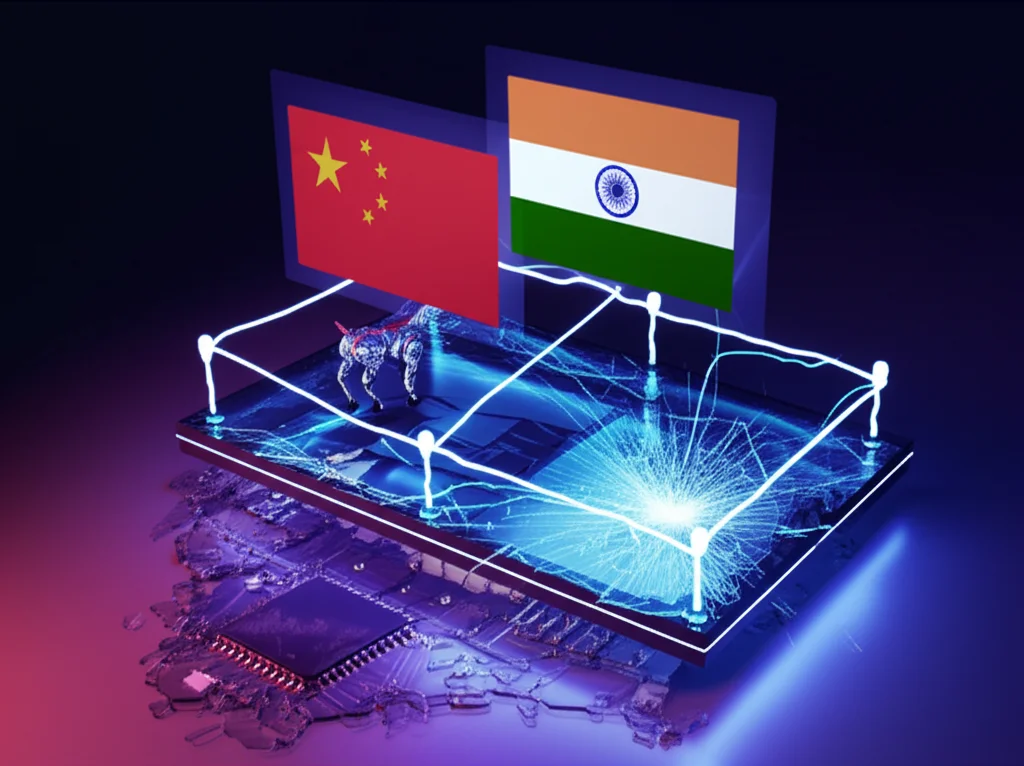
The Chinese Robodog Incident: How One PR Blunder Overshadowed India's Biggest AI Event
TL;DR
Galgotias University showcased a Chinese-made Unitree Go2 robot dog as its own creation at India's AI Impact Summit 2026. The stunt was caught within hours, went viral globally, and got the university evicted from the summit. It became the most talked-about moment of an event that had 20 heads of state and $100 billion in investment pledges.
The Summit That Was Supposed to Make History
The India AI Impact Summit 2026, held at Bharat Mandapam in New Delhi from February 16-20, was designed to be India's moment on the global AI stage. Nearly 20 heads of state attended, including French President Emmanuel Macron and Brazilian President Lula da Silva. Google CEO Sundar Pichai, OpenAI's Sam Altman, and Anthropic's Dario Amodei were in the audience. Over $100 billion in AI investment pledges were announced.
The event positioned India as the first Global South nation to host a summit of this scale. The messaging was clear: India isn't just consuming AI, it's building it.
Then a professor, a camera, and a robot dog unraveled the narrative.
What Actually Happened
On the expo floor of the summit, Galgotias University, a private institution based in Greater Noida, Uttar Pradesh, had an exhibition stall. Neha Singh, a professor of communications at the university, appeared on DD News and presented a quadruped robot she called "Orion."
"This has been developed by the centres of excellence at Galgotias University," she told the camera.
Social media users identified the robot within hours. It was a Unitree Go2, a commercially available quadruped manufactured by China's Unitree Robotics. You can buy one for $1,600 to $2,800. Universities and research labs around the world use them. It's a well-known product in the robotics community. Not exactly something you can pass off as homegrown.
The embarrassment deepened when IT Minister Ashwini Vaishnaw was found to have shared the video clip on his official social media account before the backlash erupted. He later deleted the post.
And it didn't stop at the robodog. Further scrutiny revealed that a "Drone Soccer" exhibit at the same stall, which the university claimed to have built on campus, appeared to be a Striker V3 ARF manufactured by South Korea's Helsel Group. A pattern of misrepresentation, not a one-off mistake.
Three Apologies in 24 Hours
Galgotias University's crisis response was a case study in what not to do.
Statement one (Tuesday, 7:49 PM): Posted on X claiming "Galgotias has not built this robodog, neither have we claimed" and that it had "recently acquired" the robot from Unitree. This directly contradicted what Singh had said on camera.
Statement two: A philosophical pivot. The university argued that while it didn't build the machine, "what we are building are minds that will soon design, engineer, and manufacture such technologies." The internet was not moved.
Statement three: An actual apology. The university acknowledged the confusion and threw Singh under the bus, calling her "ill-informed" and "not authorized to speak to the press." They said she gave "factually incorrect information" because of her "enthusiasm of being on camera."
The university clarified Singh was not suspended but was "asked to stay until the investigation is complete."
The Government's Response
IT Secretary S. Krishnan didn't mince words. "If you mislead... we do not want a controversy, so we do not want a controversial agency... whom people believe are exhibiting something which is not theirs," he told reporters.
The response was swift: power supply to the Galgotias University pavilion was cut, and the university was ordered to vacate its stall.
It was a remarkable scene. At a summit designed to showcase India's technological prowess, the most viral moment was the government kicking out an exhibitor for faking innovation.
Why "Made in China" Hit Different
The incident wouldn't have blown up like this if the robodog had been, say, American or European. The geopolitical context matters.
India-China relations remain strained. The border tensions in Ladakh, the app bans, the push for self-reliance under "Make in India" and "Atmanirbhar Bharat" all create a heightened sensitivity around Chinese products being passed off as Indian innovation. At a summit where India was explicitly positioning itself as a tech sovereign, a Chinese robot wearing an Indian label was more than a PR gaffe. It felt like a symbolic contradiction.
China's Global Times ran a story headlined "'Embarrassment': international media, netizens scrutinize Indian university's false claim." Not the international headline India wanted from its marquee AI event.
The Political Fallout
Opposition parties saw an opening.
Rahul Gandhi called the summit a "disorganised PR spectacle" and wrote: "Indian data up for sale, Chinese products showcased." Samajwadi Party MLAs raised the issue in the Uttar Pradesh Assembly during Zero Hour, demanding a formal investigation into how the university got a stall in the first place.
The row reached the state legislature within 48 hours. For context, this was a university exhibition stall. The speed of political escalation says more about the sensitivity of the topic than the severity of the act itself.
The Real Question: How Did They Get a Stall?
This is the part nobody has adequately answered.
The India AI Impact Summit wasn't a college fair. It was a curated, high-security event with heads of state in attendance. Exhibitors were presumably vetted. Security was tight. So how did a university with no original robotics IP end up with exhibition space at the nation's most important tech event?
Was it poor vetting? Political connections? A bureaucratic oversight? The fact that Galgotias is a private university in Uttar Pradesh, a state governed by the BJP, inevitably invites questions about how stall allocations were decided.
IT Secretary Krishnan's public response suggests the government was genuinely caught off guard. Which raises a different concern: if the vetting process can miss something this obvious, what else slipped through?
Lessons in Event PR and Tech Summitry
Beyond the politics and the memes, the robodog incident offers three practical lessons for anyone organizing or participating in major tech showcases.
Vet your exhibitors. A five-minute Google search would have identified the Unitree Go2. If summit organizers had required exhibitors to provide documentation of IP ownership or development provenance for the products they showcased, this wouldn't have happened.
Your weakest exhibitor defines your brand. The summit had 688 articles written about it. Sundar Pichai delivered a keynote. Macron announced partnerships. But ask anyone what they remember about the India AI Impact Summit 2026, and a significant number will say: the Chinese robot dog. One bad stall can overshadow a billion dollars in pledges.
Crisis communication basics still apply. Galgotias needed one clear statement, issued quickly, taking responsibility. Instead, they issued three contradictory statements in 24 hours, blamed a professor, and tried philosophy. By the time the apology came, the story had already been covered by Bloomberg, NBC News, Al Jazeera, the South China Morning Post, and Fortune.
India's AI Story Is Real, But Fragile
Here's the thing: India's AI credentials are genuine. The country has over 600 AI startups. It showcased 12 indigenous AI models at the summit. The Digital India ecosystem, UPI, Aadhaar, and CoWIN represent real-world AI deployment at population scale that most countries can't match.
But credibility is fragile. It takes years to build and seconds to damage. The robodog incident didn't invalidate India's AI story, but it gave critics an easy, viral symbol to point to. Every future claim of Indian AI innovation now carries a faint asterisk.
The fix isn't better PR. It's better gatekeeping. If India wants to host world-class tech events, it needs world-class curation. Letting a private university pass off a $1,600 Chinese robot as indigenous innovation at a summit attended by 20 heads of state isn't just embarrassing. It's a governance failure.
Sources
- Al Jazeera: Indian university faces backlash for presenting Chinese robot as its own
- NBC News: A robotic dog made in China gets an Indian university kicked out of an AI summit
- Bloomberg: Indian university told to exit AI summit over robot claim
- Fortune: India's AI embarrassment
- Euronews: University booted from India AI summit
- South China Morning Post: Robot dog claim slammed as 'shameless'
- India TV News: Galgotias University apologises
- The Federal: Robodog row explained
- Republic World: Galgotias University vacates AI summit stall
- Tribune India: Galgotias evicted from AI summit
- Dawn: India tells university to leave AI summit
- Global Times: International media scrutinize Indian university's false claim