Filter Bubble vs Echo Chamber: What's the Real Difference?
TL;DR: "Filter bubble" and "echo chamber" get tossed around as synonyms, but they describe fundamentally different problems. A filter bubble is what the algorithm does to you without your knowledge. An echo chamber is what you do to yourself, and then defend. The distinction matters because each requires a completely different fix, and getting it wrong can actually make things worse.
The Two Friends Who Googled "Egypt"
In 2011, internet activist Eli Pariser stood on a TED stage and showed the audience something unsettling. He had asked two friends to search for the word "Egypt" on Google and screenshot their results. One friend got links about the Egyptian revolution unfolding in Tahrir Square. The other got travel tips and hotel deals. Same word, same search engine, two entirely different realities.
Pariser had a name for what was happening. He called it the filter bubble, a concept he unpacked in his 2011 book of the same name. Google, he revealed, was using 57 different signals, from your location to the type of computer you were using, to quietly tailor search results to what it thought you wanted to see. Facebook was doing something similar: Pariser noticed that his conservative friends had vanished from his News Feed. The algorithm had noticed he clicked on liberal links more often, and without asking, it had edited out the rest.
The phrase stuck. Within a few years, "filter bubble" became shorthand for everything wrong with algorithmic media. But somewhere along the way, it got tangled up with another phrase that sounds similar but means something quite different: the echo chamber.
A Legal Scholar Saw It Coming First
Before Pariser coined his term, Harvard Law professor Cass Sunstein had been warning about a related but distinct problem. In his 2001 book Republic.com, updated in 2017 as #Republic: Divided Democracy in the Age of Social Media, Sunstein argued that the internet would let people build what he called "communication universes in which we hear only what we choose and only what comforts and pleases us."
His concern was not about algorithms. It was about choice. People would voluntarily sort themselves into like-minded communities and then, through a process Sunstein called group polarization, become more extreme versions of themselves. If Republicans talk only to Republicans, they become more Republican. If Democrats talk only to Democrats, they become more Democratic. The echo chamber is not a glitch in the system. It is the system working exactly as its inhabitants want it to.
This distinction, between being passively filtered and actively choosing, is where most public conversation goes wrong. When a politician blames "echo chambers" for misinformation, they are often really describing filter bubbles. When a tech critic blames "filter bubbles" for polarization, they are often really describing echo chambers. The two problems have different causes, different mechanics, and critically, different solutions.
The Philosopher Who Drew the Sharpest Line
The clearest articulation of this difference comes from philosopher C. Thi Nguyen at the University of Utah, whose 2020 paper in the journal Episteme has become the definitive framework for distinguishing the two concepts.
Nguyen argues that the confusion stems from collapsing two separate structures into one. He breaks them apart like this:
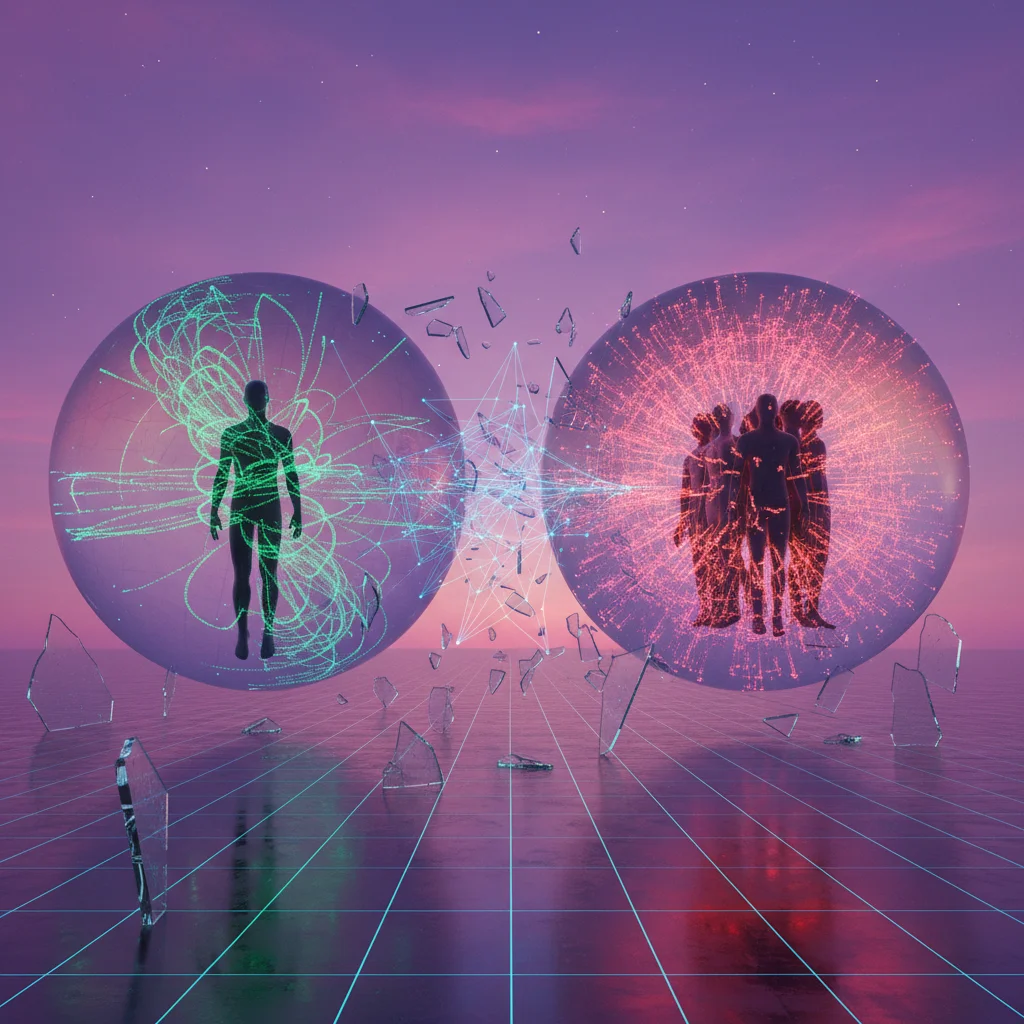
A filter bubble (which Nguyen calls an "epistemic bubble" in its broader form) is a structure where other voices are simply absent. You don't hear the other side. The omission might be accidental, it might be algorithmic, but the key feature is that contrary information just never reaches you. And because it never reaches you, you don't even know it exists.
An echo chamber is something far more resilient. It is a structure where other voices have been actively discredited. You do hear the other side, but you have been systematically taught not to trust them. Outsiders are not just absent; they are portrayed as liars, shills, or enemies. Inside sources are elevated as the only reliable authorities.
The practical consequence of this distinction is enormous. An epistemic bubble is fragile. Nguyen compares it to a soap bubble: pop it with a single piece of contrary evidence, and it bursts. Show someone in a filter bubble a well-sourced article from the other side, and they might update their view.
An echo chamber is built to resist exactly that. Show someone in an echo chamber the same article, and the echo chamber's internal logic kicks in: "Of course they would say that. That's exactly what the mainstream media wants you to think." Exposure to contrary evidence does not weaken the echo chamber. It can actually strengthen it. As Nguyen writes, the mechanism "bears a striking resemblance to some accounts of cult indoctrination."
What Does the Evidence Actually Say?
If you have spent any time reading about digital media, you have probably absorbed the idea that the internet is carving society into sealed ideological silos. The research tells a more complicated story.
The most comprehensive review to date, a 2022 literature survey by the Reuters Institute at Oxford, led by Dr. Amy Ross Arguedas, Dr. Craig Robertson, Dr. Richard Fletcher, and Prof. Rasmus Kleis Nielsen, found that echo chambers are "much less widespread than is commonly assumed" and that the evidence offers "no support for the filter bubble hypothesis."
Their numbers are striking. In the UK, only about 2% of the population occupies a left-leaning partisan echo chamber, and roughly 5% occupies a right-leaning one. Across most European countries, fewer than 5% of people live in politically partisan online news echo chambers. The United States is an outlier, with more than 10% consuming predominantly one-sided partisan news sources, though even that figure is far below the impression created by public discourse.
More surprisingly, the review found that algorithmic filtering through search engines and social media generally leads to slightly more diverse news consumption, not less. The filter bubble hypothesis predicted the opposite. The actual data suggests that people who use social media for news encounter a wider range of sources than those who don't.
A systematic review of 129 echo chamber studies published in the Journal of Computational Social Science in April 2025 found the same split. Studies using computational methods that measured who follows whom (homophily-based approaches) tended to confirm echo chambers. Studies that actually measured what content people see and read tended to reject them. The method you choose to measure the phenomenon substantially determines whether you find it.
The Algorithm Might Not Be the Villain
One of the most counterintuitive findings in recent research comes from a May 2026 study published in PLOS ONE by Petter Törnberg at the University of Amsterdam. Using an agent-based model of 2,000 simulated users across 20 communities, Törnberg showed that strong ideological segregation can emerge without any algorithmic personalization at all, and without users even preferring homogeneous environments.
The mechanism is simple: when a community develops a slight imbalance, the minority members become uncomfortable and leave. Their departure makes the remaining group more homogeneous, which makes the next set of minority members uncomfortable, and so on. The process cascades. Small imbalances snowball into total segregation. And the tipping point is remarkably low: users only need to require about 10% of their community to share their views before the sorting begins.
Here is the kicker: when Törnberg added algorithmic personalization to his model, it actually reduced segregation. The algorithm, by curating content that kept users satisfied, lowered their motivation to leave mixed communities. The very thing blamed for creating bubbles was, in certain conditions, preventing them.
This aligns with research from the University of Twente published in March 2026. Dr. Shenja van der Graaf and Dr. Alex van der Zeeuw tracked the search results of nearly 400 Dutch users over three months and found that personalization creates "temporary configurations of information" that "dissolve again and make way for new ones." Digital polarization, they concluded, is "not a stable condition, but rather a mirage: what appears to be fixed is constantly shifting."
Axel Bruns, a professor at Queensland University of Technology, puts it even more bluntly. Filter bubbles and echo chambers, he argues, are "very suggestive metaphors, but ultimately they're myths." Completely encapsulating oneself in a filter bubble, he says, would require "cult-like effort that few ordinary people would commit to."
India's Echo Chamber Problem Is Real, But It Looks Different
The global research is largely Western, and what applies to Google and Facebook in Europe does not automatically apply to a country where 83% of internet users communicate through WhatsApp and where over 500 million people use social media in 22 official languages.
India's echo chamber problem is less about algorithms and more about group identity. A February 2026 study published on ScienceDirect examined Indian voters aged 18 to 35 and found that two forces operate in tandem: network homophily (who you connect with) and algorithmic recommendation (what the platform shows you). The first reduces cross-cutting exposure. The second amplifies whatever the first selects. Together, they create partisan clustering that is difficult to break.
But the platform that matters most in India is not Facebook or Google. It is WhatsApp. And WhatsApp has no algorithm in the filter-bubble sense. There is no recommendation engine deciding what you see. Messages arrive in chronological order from the groups you chose to join.
This makes India's problem primarily an echo chamber phenomenon, in the Nguyen sense. You choose your groups. Your groups reflect your caste, your religion, your political alignment. And within those groups, outside voices are not just absent; they are actively distrusted.
A 2024 study of rural WhatsApp groups in Jharkhand laid bare the mechanics. The researchers analyzed 604 viral messages across caste-based, religious, and general community groups. Caste-specific groups comprised only 8% of total messages but accounted for 45% of all viral content. Twenty-six percent of all viral content was outright misinformation. And 44% of that misinformation was designed to incite hatred against Muslims.
Perhaps the most damning finding: across all 604 messages examined, not a single instance of fact-checking appeared. The echo chamber was complete. No outside voice challenged the content. No link to a fact-check surfaced in the stream. The groups functioned, in the researchers' words, as "fertile grounds for the perpetuation of hate speech and misinformation."
A separate Nature study analyzing approximately two million WhatsApp messages in India found that virally forwarded content, marked by WhatsApp as "forwarded many times" (meaning it had passed through at least five hops), was the primary vector for misinformation. The sheer volume is hard to grasp: India has over a billion internet users, and WhatsApp is the default communication layer for most of them.
Political parties have adapted. Reporting by the Pulitzer Center documented how India's ruling BJP operates a sophisticated WhatsApp distribution network. When WhatsApp introduced forwarding limits to slow misinformation, users simply copied messages instead of forwarding them, bypassing the restriction entirely. Content deemed too inflammatory for official party groups circulated freely in affiliated ones.
A Systematic Review of 30 Studies Confirms the Pattern
A systematic review of 30 peer-reviewed studies spanning 2015 to 2025, published in the journal Societies in October 2025, analyzed the interplay of filter bubbles, echo chambers, and algorithmic bias in shaping youth engagement. The breakdown revealed where academic attention has focused: algorithmic processes (40% of studies), socio-political impacts (27%), youth behavioral responses (20%), and interventions and solutions (13%).
That last number is telling. Only 13% of studies examined how to actually fix the problem. The research community has spent far more energy documenting the phenomenon than figuring out what to do about it.
Why the Distinction Actually Matters
Getting the diagnosis right determines whether the treatment works.
If the problem is a filter bubble, the fix is transparency. Show people what the algorithm is hiding. Let them toggle between personalized and chronological feeds. Require platforms to disclose how recommendations are generated. These are regulatory and design solutions, and they can work because the user is a passive recipient who simply needs to see what was hidden.
If the problem is an echo chamber, transparency alone will fail. You cannot pop an echo chamber by showing someone a contrary news article, because the echo chamber has already pre-inoculated its members against outside sources. The fix requires something harder: rebuilding trust in diverse sources, creating spaces for cross-cutting dialogue, and addressing the underlying social identities that make people want the echo chamber in the first place.
In India, where the dominant platform has no algorithmic feed and where group membership tracks caste, religion, and party affiliation, the filter-bubble framing is almost entirely wrong. Calling for "algorithm transparency" on WhatsApp makes no sense. The platform is already transparent. The problem is not what the machine shows you. The problem is what your community tells you to believe and who they tell you not to trust.
Research from the Heinrich Böll Stiftung confirms this broader pattern: the average internet user is exposed to greater diversity of opinion online compared to offline news consumption. The real concentration of ideological isolation happens not among typical users but among "radicalized, non-mainstream groups" who have opted into information environments that systematically exclude and discredit outside voices.
What You Can Actually Do
Understanding the distinction changes what solutions make sense.
For filter bubbles: - Use multiple search engines. Switch between Google, DuckDuckGo, and Bing. - Clear your browsing history periodically. Open news in incognito mode. - Subscribe to newsletters from outlets you disagree with. - Use news aggregators like The Balanced News that surface coverage from across the political spectrum for the same story.
For echo chambers: - This is harder. Simply following an opposing account will not work if you have been primed to distrust everything they say. - Start with bridge figures: journalists, academics, or commentators who are respected across political lines. - Pay attention to the language your community uses about outsiders. If every critic is dismissed as a "paid agent" or "anti-national," you are inside an echo chamber. - Fact-check claims that confirm your existing beliefs more rigorously than claims that challenge them. Confirmation bias is the fuel; skepticism of your own side is the antidote.
The Bigger Question
The metaphors of bubbles and chambers have dominated media literacy conversations for 15 years now. But the latest findings from Oxford and Twente indicate they may have been drawing attention away from a more fundamental question: not what the internet does to our information, but what existing social structures, our identities, our group loyalties, our willingness to distrust outsiders, do with the internet.
As the University of Twente researchers concluded, search engines and social media do not create ideological categories. They build on existing social structures. The divisions are not digital. They are human. The technology just makes them visible.
The question is not whether you are in a filter bubble or an echo chamber. The question is whether you are willing to trust a voice from outside your circle, and whether the platform you are using makes that easier or harder.
Sources
- Eli Pariser, "Beware online filter bubbles," TED Talk, 2011 - Origin of the "filter bubble" concept and the Google "Egypt" experiment
- Filter bubble, Wikipedia - Background on the concept and Google's 57 personalization signals
- Cass Sunstein, #Republic: Divided Democracy in the Age of Social Media, Princeton University Press, 2017 - Echo chamber concept and group polarization theory
- C. Thi Nguyen, "Echo Chambers and Epistemic Bubbles," Episteme, Vol. 17, Issue 2, 2020 - Definitive philosophical distinction between echo chambers and epistemic bubbles
- Arguedas, Robertson, Fletcher, Nielsen, "Echo chambers, filter bubbles, and polarisation: a literature review," Reuters Institute, 2022 - UK data: 2% left / 5% right in echo chambers; no support for filter bubble hypothesis
- Petter Törnberg, "Echo chambers can emerge without algorithmic personalization," PLOS ONE, May 2026 - Agent-based model showing algorithms may reduce segregation
- University of Twente, "UT research debunks the filter bubble myth," March 2026 - 400 users tracked; filter bubbles are "temporary configurations," not fixed
- Systematic review of echo chamber research, Journal of Computational Social Science, Springer, April 2025 - 129 studies analyzed; method determines whether echo chambers are found
- Trap of Social Media Algorithms, MDPI Societies, October 2025 - 30 studies reviewed; only 13% examined interventions
- India young voters echo chamber study, ScienceDirect, February 2026 - Network homophily + algorithms jointly polarize Indian voters aged 18-35
- Deciphering Viral Trends in WhatsApp: Rural India Case Study, arXiv, 2024 - 26% of viral content was misinformation; caste groups = 8% of messages but 45% of viral content
- India AI misinformation study, Nature, 2024 - ~2 million WhatsApp messages analyzed
- Inside the BJP's WhatsApp Machine, Pulitzer Center - How political parties circumvent forwarding limits
- Axel Bruns, "Filter Bubbles and Echo Chambers: Debunking the Myths," DMRC at Large, Medium - Filter bubbles are "very suggestive metaphors, but ultimately myths"
- Heinrich Böll Stiftung, "What are Filter Bubbles and Digital Echo Chambers?", 2022 - Average user sees more diversity online than offline
- DataReportal, "Digital 2026: India" - India social media statistics: 500M+ users, 83% on WhatsApp