India's Smart Border Project: Surveillance or Security?
TL;DR: India's Home Minister just announced a plan to blanket 6,000 km of border with AI cameras, drone radars, and seismic sensors within a year. The security logic is real: fencing alone has failed on riverine and marshy stretches. But the project arrives without a privacy framework, independent oversight, or any public debate about what happens when the same technology points inward.
On May 22, 2026, Union Home Minister Amit Shah stood at Vigyan Bhawan in Delhi and told a room full of Border Security Force officers that India's borders would soon become "virtually impenetrable." Speaking at the BSF Investiture Ceremony, Shah announced what the Ministry of Home Affairs is calling the "Smart Border" project: a plan to replace physical fences and human patrols with an AI-powered surveillance grid stretching from Gujarat to Mizoram.
"Within the coming year itself, the government is moving forward with equipping BSF security systems with every kind of technology to create an impenetrable border security grid," Shah said, as Outlook India reported from the ceremony. The project would equip the BSF with "drones, radars, advanced cameras and other modern technologies."
The announcement landed like a thunderclap in defence circles. In newsrooms, it barely registered.
What the Smart Border Actually Includes
The details, pieced together from the MHA's own border management division page and reporting by the Daily Pioneer, describe a system far more ambitious than anything India has attempted before.
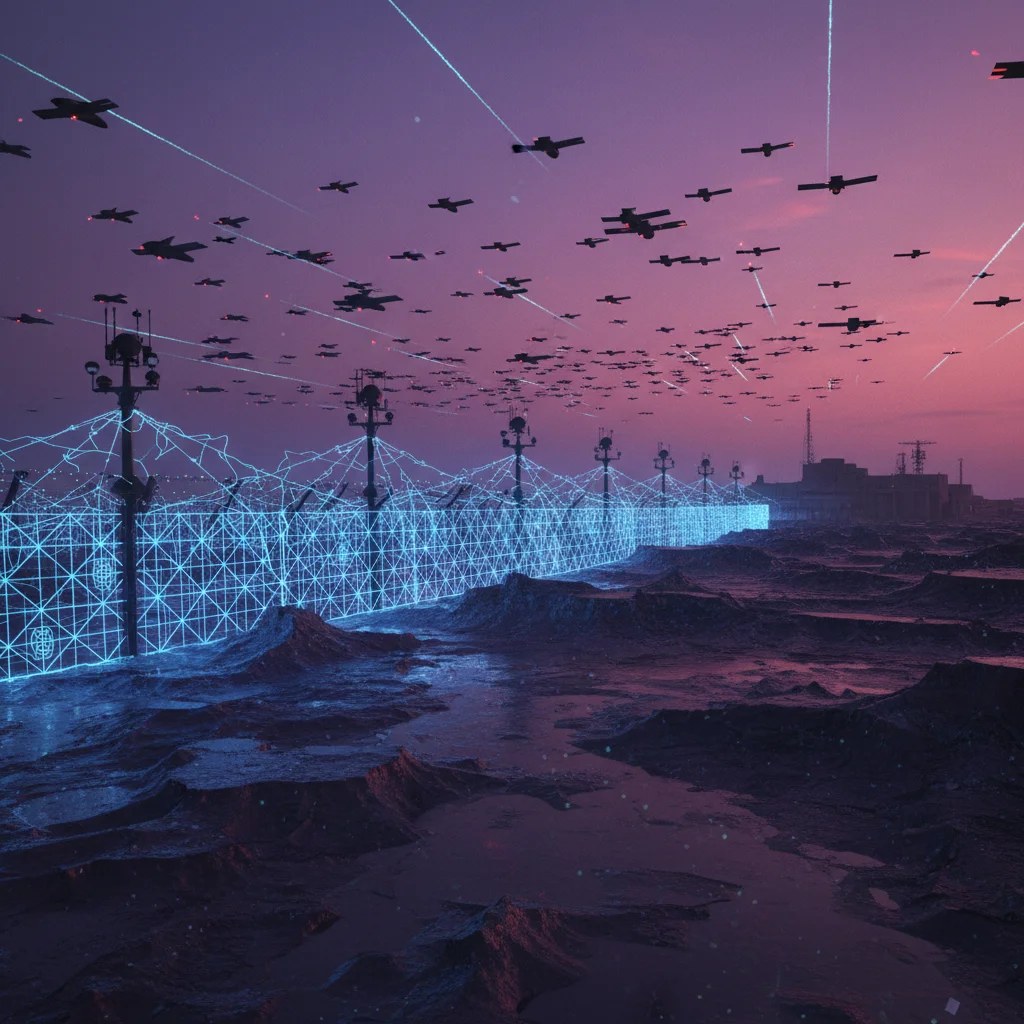
At the hardware level, the Smart Border comprises thermal-imaging cameras that detect human body heat through darkness and fog, AI-equipped CCTV that can distinguish between a human, an animal, a vehicle, and a drone, ground-surveillance radars that pick up movement several kilometres away, fibre-optic sensors buried along fence lines, seismic sensors that register footsteps and vehicle vibrations, and underground monitors designed to detect tunnelling.
Above the ground, uncrewed aerial vehicles, both fixed-wing and rotary drones, will run autonomous patrol routes with high-definition and thermal cameras feeding real-time video to centralised command centres. Below the surface, the system includes laser beams and tunnel-detection technology.
The entire apparatus feeds into Centralised Command and Control Centres connected by high-speed fibre-optic and satellite networks. AI and machine learning algorithms will process the data in real time, filtering false alarms, predicting infiltration patterns, and pushing instant alerts to the nearest BSF post and quick-reaction teams.
If it works as described, the Smart Border would function as a 6,000-km digital nervous system.
Why the Fence Wasn't Enough
The government's pivot to technology is not arbitrary. India has been building border fences for decades, and the numbers tell a story of diminishing returns.
Along the India-Pakistan International Border (2,289 km), fencing now covers 93.25% of the stretch, or about 2,135 km. The India-Bangladesh border (4,096.70 km) is 79.08% fenced, with 3,239 km covered. The India-Myanmar border (1,643 km) remains almost entirely unfenced at less than 2%, with only about 30 km of barriers in place.
The problem is that fences work on flat, dry land. They fail spectacularly on rivers, marshes, flood plains, and mountains. Along the India-Pakistan border alone, approximately 145 km of unfenced riverside stretches remain vulnerable, particularly where the border crosses the Ravi, Chenab, and Sutlej rivers. On the Bangladesh side, the Brahmaputra's ever-shifting channels in Assam's Dhubri district have made physical fencing impossible across a 61-km stretch.
This is where the Comprehensive Integrated Border Management System, or CIBMS, first entered the picture. Conceived in 2016 after the Pathankot Air Force Station attack, the CIBMS was India's first attempt at a "virtual fence." Pilot projects covered 71 km across the Pakistan border (10 km) and Bangladesh border (61 km). A second phase planned 153 km in four patches. A third phase targeted 1,802 km across 67 patches.
The BOLD-QIT project, or Border Electronically Dominated QRT Interception Technique, extended the concept specifically to the Brahmaputra's riverine stretches in Dhubri, Assam. Inaugurated on March 5, 2019, by then-Home Minister Rajnath Singh, it deployed microwave communication, optical fibre, digital mobile radio, day-night cameras, and intrusion detection across the 61-km gap.
The Smart Border project is essentially CIBMS and BOLD-QIT scaled to the entire frontier, with AI layered on top.
The Money Trail
Border security does not come cheap, and the budget numbers have been climbing steeply.
The Border Infrastructure and Management (BIM) Scheme carries an approved outlay of Rs 13,020 crore for 2021-22 to 2025-26, covering fences, roads, floodlights, border outposts, helipads, and technology deployments. The Union Budget 2025-26 allocated Rs 5,597 crore for border management, a jump of nearly 50% from the previous year's Rs 3,756 crore.
For the Myanmar border alone, the Cabinet Committee on Security has approved Rs 31,000 crore to be spent over a decade on fencing, electronic surveillance, anti-drone technology, tunnel detection, high-mast lighting, and watchtowers.
No separate budget figure has been announced for the Smart Border project itself. This is worth noting. A project of this scale, covering 6,000 km with AI-driven sensors and command centres, will carry enormous procurement, installation, and maintenance costs. The absence of a published budget before the announcement raises questions about whether this is a fully costed programme or a political signal.
Drones: The New Variable
The rising drone threat along India's western border has added urgency to the tech pivot.
In Punjab alone, 35 drones were neutralised by police in April 2025, all identified as Chinese-manufactured DJI models being used to ferry narcotics and weapons across the India-Pakistan border. The problem is growing: anti-drone systems deployed across the 554-km Punjab border face limitations in range, weather sensitivity, and cost.
The Indian Army is responding with scale. Chief of Army Staff General Upendra Dwivedi has unveiled a restructuring plan targeting 8,000 to 10,000 drones per corps, with traditional infantry units embedding dedicated drone platoons of 30 to 70 personnel. Roughly 50,000 armed forces personnel are currently being trained for drone-related operations, with 15 specialised Centres of Excellence planned.
The Smart Border's anti-drone component, including radar systems capable of tracking more than 100 drones simultaneously at ranges exceeding 15 km, is designed to plug exactly this gap.
But drones also expose a dependency problem. An estimated 60% to 70% of critical components in Indian-owned drones, including motors, sensors, and batteries, are sourced from China. A border security system reliant on a rival's supply chain carries obvious strategic risks.
How Other Countries Have Done This
India is not the first country to attempt a technology-driven border. The track record elsewhere is instructive.
The United States spent $1 billion on a "virtual border fence" under President George W. Bush, only for then-Secretary of Homeland Security Janet Napolitano to scrap it in 2011 due to persistent technology failures and deployment problems. The US then pivoted to autonomous surveillance towers built by Elbit Systems of America, a subsidiary of the Israeli defence contractor that built smart fences in the West Bank and Golan Heights. In 2014, the Obama administration awarded Elbit a $145 million contract for 52 surveillance towers across southern Arizona.
The pattern is telling. Successive US administrations, regardless of party, presented smart-border technologies as more humane than physical walls. In practice, the technology became a bipartisan growth industry for defence contractors. By 2023, Israel had approved the marketing of border and surveillance technology to more than 100 countries.
India has not disclosed which vendors will supply the Smart Border hardware and software. Given the scale and the existing relationship between Indian and Israeli defence industries, the procurement choices will be worth watching.
The Surveillance Question Nobody Is Asking
This is where the coverage gap becomes a canyon.
India's Smart Border announcement has generated hundreds of news articles, almost all focused on the security benefits. Virtually none have asked the obvious follow-up: what legal framework governs a 6,000-km AI surveillance grid?
The concern is not hypothetical. India already operates a surveillance infrastructure that has drawn criticism from domestic and international observers. The Central Monitoring System (CMS) gives the government direct access to communications across mobile, landline, and internet platforms without requiring service provider authorisation. The Defence Research and Development Organisation's NETRA (Network Traffic Analysis) monitors internet traffic and flags suspicious keywords. NATGRID aggregates financial, immigration, and telecommunications records. None of these systems operate under independent judicial oversight.
The Digital Personal Data Protection Act of 2023 was supposed to bring order to this landscape. Instead, Section 17 of the DPDPA grants government agencies broad exemptions to process personal data without consent for reasons including "national security" and "public order." The Internet Freedom Foundation has noted that the law lacks adequate measures to prevent "over-broad surveillance." The Editors Guild of India warned it would hamper press liberty.
The Supreme Court's 2017 Puttaswamy decision established privacy as a fundamental constitutional right, requiring any state intrusion to meet tests of legality, necessity, and proportionality. But the IAPP (International Association of Privacy Professionals) has argued that the DPDPA's "vague definitions and expansive exemptions for government agencies undermine these principles."
Suresh Kumar, the former Chief Principal Secretary to the Chief Minister of Punjab, put it plainly in a Cornell University study on digital governance at the India-Pakistan border: "The chilling effect of surveillance must be minimised, and that is only possible when the public knows that our actions are guided by fairness, transparency, and necessity."
The Communities Caught in the Middle
Border security discussions in Delhi rarely account for the people who actually live on borders.
India has 92 border districts across 17 states, and the communities in these areas have long lived under layers of restrictions on movement, land use, and daily life. The Observer Research Foundation's analysis of CIBMS implementation found that approximately 24,000 acres across 212 villages in Punjab border districts have remained entangled in land acquisition disputes since 1988, with an audit finding that 66% of cases experienced "abnormal delays," some exceeding nine years.
Border observation posts in many areas lack basic facilities such as electricity and water connections. The ORF paper notes that deploying hi-tech equipment requires "standardised defence infrastructure" that simply does not exist in many guarded areas. This is not just a logistics problem. It means that border communities experience the restrictions of a security zone without even the collateral benefit of infrastructure development.
The government has launched programmes to address this. The Border Area Development Programme (BADP) and the Vibrant Villages Programme aim to provide healthcare, education, and skills training to border communities. Whether these are enough to offset the lived experience of living under round-the-clock surveillance is a different question.
On the Myanmar border, the situation carries an additional complication. The National Unity Government (the government in exile of Myanmar) has urged India to suspend border fencing, calling it "unilateral" and undertaken in areas where the boundary itself "remains unresolved." India has so far ignored this objection, but the Rs 31,000 crore Myanmar fencing project will inevitably affect cross-border ethnic communities, including the Kuki, Naga, and Chin peoples who straddle both sides.
What the Media Got Wrong (and Right)
Indian media coverage of the Smart Border announcement can be divided into two piles.
Pile one is cheerful. Outlets like ANI, ETV Bharat, and India TV ran the announcement as a security triumph. The coverage faithfully reproduced Shah's language about "impenetrable grids" and "zero tolerance." None asked about cost, timeline, vendor selection, or civil liberties.
Pile two is nonexistent. No major Indian outlet, as of this writing, has published an analysis that puts the Smart Border in conversation with India's existing surveillance infrastructure, the DPDPA's exemptions, the Puttaswamy ruling, or the lived experience of border communities. The US State Department's 2024 human rights report on India documented a pattern of civil society organisations, academics, and journalists facing "threats, harassment, arbitrary surveillance" that created a "chilling effect" on advocacy. None of this context appeared in Indian coverage of the Smart Border.
The GIGA Institute in Hamburg has warned that "by viewing all its citizens with suspicion and subjecting them to blanket mass surveillance, India risks regressing into an authoritarian state, thus undoing decades of progress made on human rights since independence."
That is a strong claim. It is also a claim that no Indian newsroom deemed worth putting alongside the Smart Border story.
The Real Question
The Smart Border project is almost certainly necessary. India's unfenced riverine and marshy stretches are genuine security vulnerabilities. Drones carrying narcotics and weapons across the Punjab border are a documented, growing threat. Electronic surveillance in areas where physical fencing cannot work is a rational response.
But "necessary" and "sufficient" are different words. A 6,000-km AI surveillance grid without independent oversight, without a published budget, without a vendor disclosure, and without a privacy impact assessment is a system that can be repurposed. The technology that watches the border can, with minimal modification, watch the border communities. And then the cities behind them.
India's choice is not between security and surveillance. It is between surveillance with accountability and surveillance without it. The fact that media coverage has not even framed this as a choice tells you something about where the conversation stands.
The border needs guarding. The question is who guards the guardians.
Sources
- The Tribune — Shah announces 'Smart Border' project to prevent infiltration — Amit Shah quotes, announcement details
- Outlook India — Amit Shah unveils 'Smart Border' plan — Shah quotes on demographic changes, technology plans
- MHA — Border Management-I Division — Official border lengths, BIM Scheme
- Daily Pioneer — Smart Border push for frontier security — Technology components breakdown
- The Business Standard — India fencing progress — Pakistan/Bangladesh fencing statistics
- CSEP — Fencing, Security and Border Management — Border fencing data, Myanmar budget
- Asian Confluence — India's Border Fence with Myanmar — Myanmar fencing status, NUG objections
- ORF — CIBMS Implementation Challenges — CIBMS stages, land disputes, infrastructure gaps
- PIB — BOLD-QIT inauguration — BOLD-QIT launch details
- PIB — BOLD-QIT project details — Technical components
- DefenceNiti — Border Management 2025 Overview — Budget figures, infrastructure stats
- Cornell University — Digital Governance at the Border in Punjab — Suresh Kumar quote, drone neutralisation data
- Aebocode — Defence Drones in India 2026 — Army drone restructuring, component dependency
- NextGen Defense — India's AI anti-drone tech — Anti-drone radar capability
- Jacobin — High-Tech Dystopia on the US-Mexico Border — US virtual fence failure
- PRISM Reports — Elbit Systems — Elbit US-Mexico contract
- openDemocracy — Israeli firms outfitting US-Mexico border — $145M Elbit contract
- Arab Center DC — Gaza as Ground Zero for border tech — Israeli border tech exports to 100+ countries
- GIGA Hamburg — Digital Surveillance and Civil Liberties in India — CMS, NETRA, authoritarian regression warning
- IAPP — India's surveillance landscape after DPDPA — DPDPA Section 17 critique, Puttaswamy reference
- Business & Human Rights Centre — India privacy law concerns — IFF and Editors Guild criticism
- ANI — Shah salutes BSF, Smart Border plan — Media coverage example
- ETV Bharat — India to launch Smart Border — Media coverage example
- India TV — Smart Border along Pakistan, Bangladesh — Media coverage example
- US State Department — 2024 Human Rights Report on India — Chilling effect on civil society
- AG Group — AI Surveillance in Defence — 140 AI surveillance setups