INS Aridhaman Explained: What a Nuclear Submarine Actually Changes for India
TL;DR: India's third nuclear-powered ballistic missile submarine, INS Aridhaman, is a 7,000-tonne vessel carrying missiles that can strike targets 3,500 km away. Its real significance isn't the submarine itself. It's that India can now keep at least one nuclear submarine on patrol at all times, making its sea-based nuclear deterrent genuinely credible for the first time.
The Headline vs the Detail
Every Indian news outlet covered INS Aridhaman's commissioning. Most led with variations of "India's nuclear power grows" or "third submarine joins fleet." A few ran the Rajnath Singh quote about "not words, but power." And then most moved on.
What got lost in the celebratory coverage was the specific reason this submarine matters. It's not about having one more boat. It's about crossing a threshold that transforms India's entire nuclear posture.
To understand why, you need to know what a nuclear triad is and why its sea-based leg was, until recently, India's weakest link.
India's Nuclear Triad: The Missing Leg
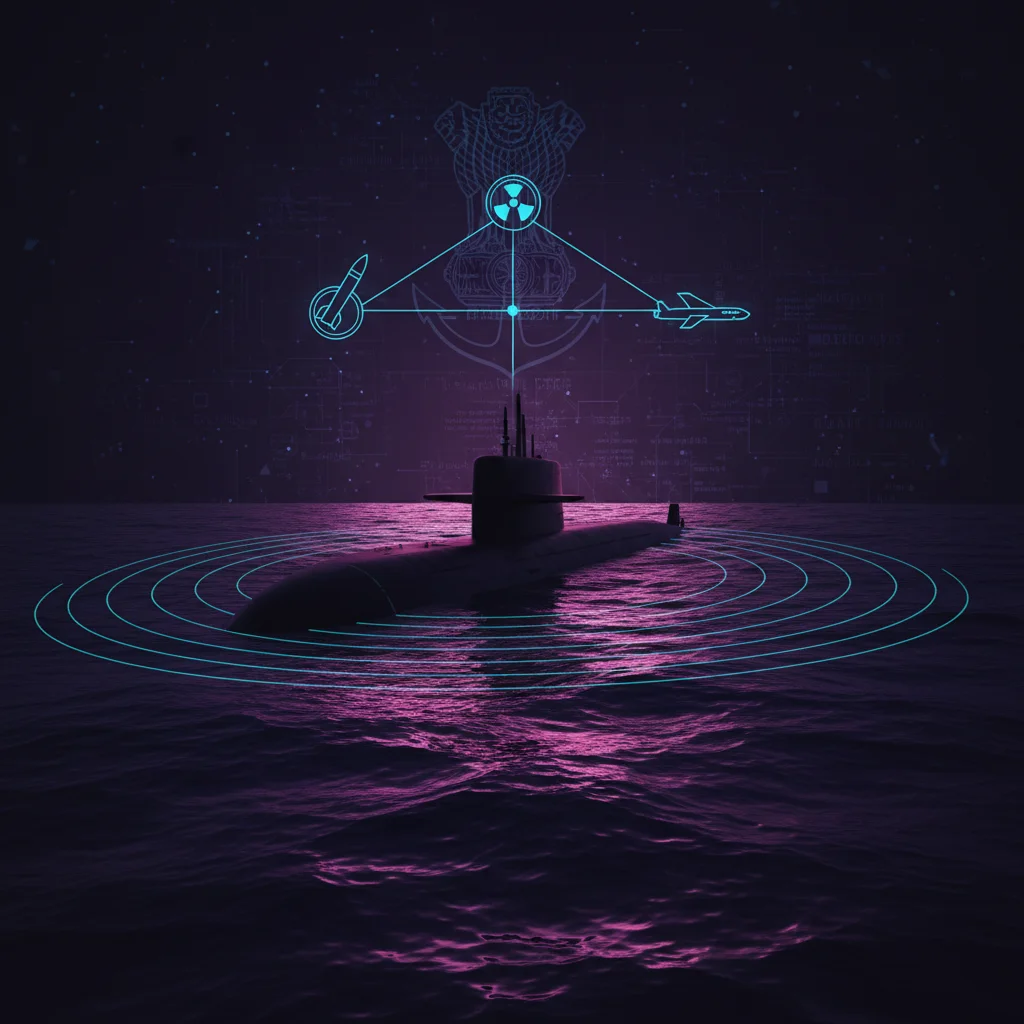
A nuclear triad is straightforward in concept. A country that can launch nuclear weapons from land (missiles in silos or on mobile launchers), air (bombers carrying nuclear-tipped missiles), and sea (submarines lurking underwater) has a triad. The logic is survivability. Even if an adversary destroys your land-based missiles and your airbases in a first strike, your submarines are somewhere under the ocean, undetectable, ready to retaliate.
India completed its triad on paper when INS Arihant was commissioned in 2016. But "on paper" did a lot of heavy lifting in that sentence.
INS Arihant carried K-15 missiles with a range of just 750 km. That's roughly the distance from Delhi to Jaipur and back. For a submarine-launched missile meant to serve as a nuclear deterrent, that range is laughably short. It would require the submarine to park dangerously close to an adversary's coastline to be useful, defeating the entire purpose of hiding underwater.
INS Arighat, commissioned in August 2024, improved things by carrying the K-4 missile with a 3,500 km range. But one submarine alone doesn't solve the problem. Submarines need maintenance. Crews need rotation. With just two boats, India couldn't guarantee that one would always be at sea.
What Three Submarines Actually Enables
This is where INS Aridhaman changes the math.
With three operational SSBNs (Ship Submersible Ballistic Nuclear, for the acronym-curious), India can now follow the rotation model used by established nuclear powers: one submarine on active deterrence patrol, one preparing for deployment, and one undergoing maintenance.
That rotation is everything. It means India's sea-based nuclear deterrent is now "continuous" rather than "occasional." In strategic parlance, this is the difference between a theoretical capability and a credible one.
The submarine itself is a significant upgrade over its predecessors:
| Feature | INS Arihant | INS Arighat | INS Aridhaman |
|---|---|---|---|
| Displacement | ~6,000 tonnes | ~6,000 tonnes | ~7,000 tonnes |
| Length | ~112 m | ~112 m | ~130 m |
| Launch tubes | 4 | 4 | 8 |
| Missile capacity | 12 K-15 or 4 K-4 | 12 K-15 or 4 K-4 | 24 K-15 or 8 K-4 |
| Max missile range | 3,500 km (K-4) | 3,500 km (K-4) | 3,500 km (K-4) |
| Reactor | 83 MW CLWR-B1 | 83 MW CLWR-B1 | 83 MW CLWR-B1 |
The doubling of launch tubes from four to eight is the standout figure. INS Aridhaman can carry eight K-4 missiles, each capable of delivering a nuclear warhead 3,500 km away. That range covers virtually all of Pakistan and significant portions of China from patrol zones within the relative safety of the Indian Ocean.
The Missile Question: K-4, K-5, and What Comes Next
The K-4 missile, tested successfully from INS Arighat in December 2025, represents the first genuinely capable submarine-launched ballistic missile in India's arsenal. At 3,500 km range with a 2-tonne warhead and roughly 100-metre accuracy (CEP), it transforms what was previously a symbolic capability into a practical one.
But the roadmap doesn't stop there. The K-5, currently under development, is expected to deliver a range of approximately 5,000 km. And the K-6, a future system reportedly designed for the next-generation S-5 class submarines, aims for 6,000 km range with multiple independently targeted warheads and hypersonic speed.
For now, the K-4 on INS Aridhaman is what matters. It allows India's submarines to remain on deterrence patrol from relatively protected zones near the Indian coast while maintaining credible strike range. No more sneaking close to hostile shorelines.
What Indian Media Skipped
Most coverage focused on the commissioning ceremony, the political optics, and broad statements about national security. Here's what rarely made it into headlines:
The base matters as much as the boat. INS Aridhaman will operate from Project Varsha, a fortified underground naval base near Visakhapatnam designed to house strategic assets away from satellite surveillance and potential strikes. A nuclear submarine is only as survivable as the infrastructure that supports it.
Indigenous content hit 75%. The Arihant-class program, part of the Advanced Technology Vessel (ATV) project, has been running since the 1990s. INS Aridhaman reportedly incorporates approximately 75% indigenous components. That's not just a nationalist talking point. It means India's ability to build, maintain, and iterate on these submarines doesn't depend on a foreign supplier who might cut off access during a crisis.
The Malacca angle. Few Indian outlets discussed the strategic implications for the Strait of Malacca, through which over 60% of China's seaborne trade and nearly 80% of its oil imports transit. India's expanding submarine fleet, operating from the Indian Ocean, adds a layer of complexity to any Chinese naval calculus in the region.
Noise and stealth. The seven-blade propeller design on INS Aridhaman is engineered to reduce acoustic signature. In submarine warfare, noise is death. A quieter submarine is a more survivable submarine, and by extension, a more credible deterrent. The advanced sonar systems USHUS and Panchendriya give it both the ability to detect threats and avoid them.
How This Changes the Regional Equation
India is not building submarines in isolation. China operates six Type 094 (Jin-class) SSBNs and is developing the next-generation Type 096. Pakistan, while lacking nuclear submarines, has pursued sea-based nuclear delivery through the Babur-3 submarine-launched cruise missile tested from conventional platforms.
India's three-submarine fleet is modest by comparison. But the strategic calculus isn't about matching numbers. It's about assured second-strike capability. With INS Aridhaman, India joins a small club of nations, alongside the US, Russia, China, UK, and France, that can maintain continuous sea-based nuclear deterrence.
The signal to both China and Pakistan is clear: a first strike against India's land-based nuclear assets would not eliminate India's ability to retaliate. That's the whole point of deterrence, and it only works if the other side believes it.
The Bottom Line
INS Aridhaman is not just a bigger submarine with more missiles. It's the piece that makes India's nuclear jigsaw puzzle functional. Without three boats, you can't maintain continuous patrols. Without continuous patrols, your sea-based deterrent is a gamble. Without a credible sea-based deterrent, your nuclear triad has a gap your adversaries can see.
India just closed that gap.
The real test now isn't another commissioning ceremony. It's whether India can sustain the operational tempo, keep expanding missile ranges with the K-5 and K-6 programs, and eventually transition to the larger S-5 class submarines that would put it on par with established undersea nuclear powers. The hardware is catching up. The question is whether the doctrine, training, and infrastructure keep pace.
Sources: - Indian Express: India inducts nuclear-powered ballistic missile submarine INS Aridhaman - Eurasian Times: India's Nuclear Triad Becomes Credible with K-4 Missile Launch - Interesting Engineering: India's 7,000-ton Nuclear Stealth Submarine - Interesting Engineering: Nuclear submarine could complicate China's sea trade routes - Deccan Herald: Indian Navy commissions 3rd nuclear submarine INS Aridhaman - Times of India: INS Aridhaman - Navy's 7000-ton nuclear stealth giant