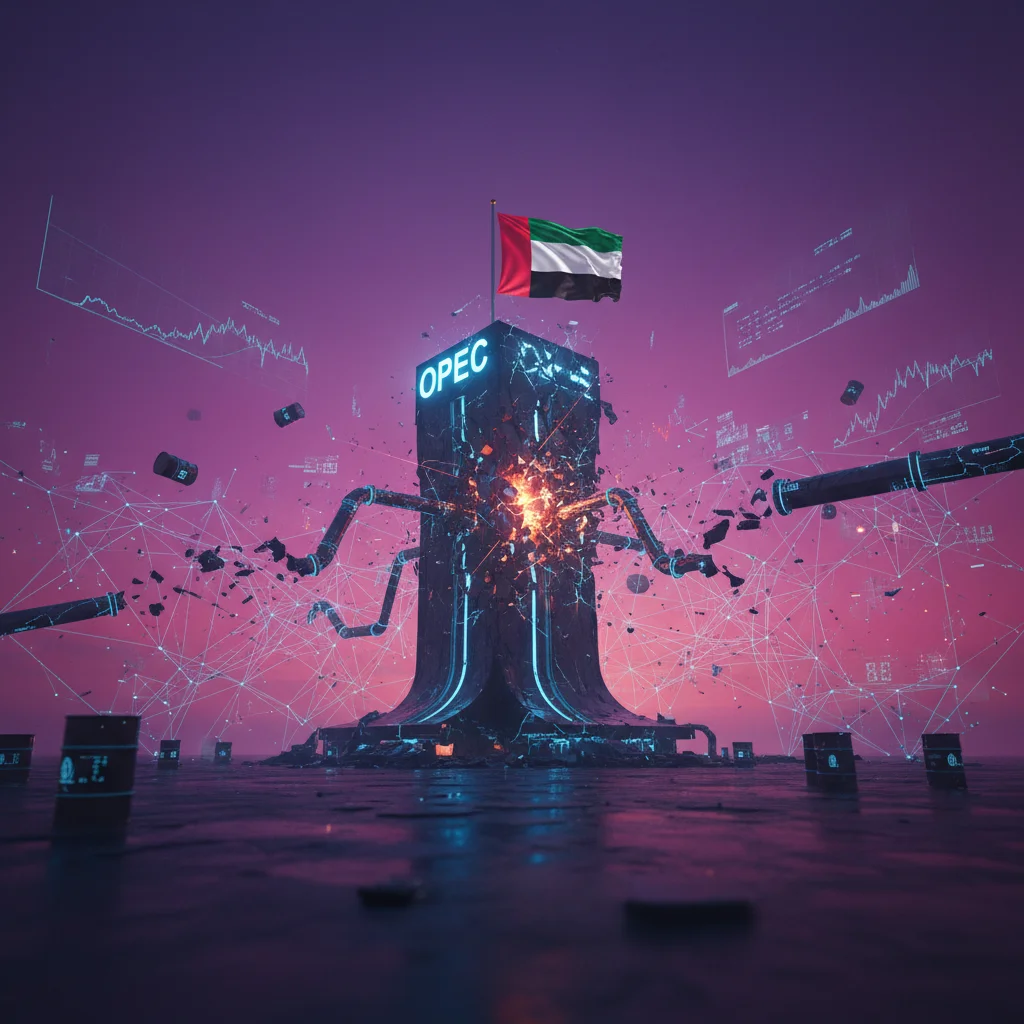
UAE Leaving OPEC: Why This Break Could Reshape Oil Politics
TL;DR
The United Arab Emirates is walking out of OPEC and OPEC+ on May 1, 2026, ending 59 years of membership. Frustrated by production quotas that kept its output far below capacity, and emboldened by the strategic cover of the Strait of Hormuz crisis, Abu Dhabi is betting that going solo will serve its interests better than staying inside a weakening cartel. For India, the world's third-largest energy consumer, this could be the best oil-market development in years.
The Announcement That Shook the Oil World
On April 28, 2026, UAE Energy Minister Suhail Al Mazrouei confirmed what market watchers had suspected for years: the UAE would leave both OPEC and the broader OPEC+ alliance, effective May 1. The statement was brief, clinical, and delivered with the diplomatic precision Abu Dhabi is known for. It cited "national interests" and the country's "evolving energy profile."
Behind those carefully chosen words lies a story of mounting frustration, geopolitical rivalry, and a cold calculation that the cartel's constraints now cost more than its benefits.
The timing was deliberate. With the Strait of Hormuz still largely closed due to the Iran conflict that began in late February, global oil markets were already in a state of disruption so severe that the UAE's exit would barely register as a blip on price charts. Al Mazrouei said as much: "Timing is right because it will not significantly impact the market and the price because the Strait of Hormuz is closed and restricted."
Brent crude nudged up 3.4% to $111.67 per barrel on the news. In any other year, losing OPEC's third-largest producer would have triggered alarm. In a market where 10 million barrels per day had already vanished from supply lines due to the Hormuz crisis, it barely registered.
59 Years Inside the Cartel
The UAE joined OPEC in 1967, just six years after the country's formal independence. Back then, oil was the sole economic engine, and OPEC membership offered small Gulf states a seat at a table dominated by heavyweights like Saudi Arabia, Iran, and Venezuela.
For decades, the arrangement worked. OPEC coordinated production cuts to prop up prices during downturns and managed surpluses to avoid price collapses. The UAE, with its relatively small population and enormous reserves, benefited from the stability.
But the relationship started souring well before 2026.
The Quota Straitjacket
The heart of the dispute is arithmetic. OPEC quotas limited the UAE to roughly 3.2 million barrels per day of production. The country's actual capacity, after billions of dollars in investment by the Abu Dhabi National Oil Company (ADNOC), stood at close to 4.85 million barrels per day. That gap of 1.6 million barrels per day is not a rounding error. At $100 per barrel, it represents roughly $58 billion a year in foregone revenue.
Ole Hansen, Head of Commodity Strategy at Saxo Bank, put it bluntly: the UAE had seized the opportunity to remove "the production quota straitjacket" that had frustrated the nation for years.
ADNOC's expansion plans made the tension unsustainable. The company launched a $150 billion capital expenditure program spanning 2023 to 2027 to push capacity to 5 million barrels per day. You don't spend $150 billion on infrastructure you can't use.
A Pattern of Friction
The friction didn't appear overnight. In 2021, the UAE publicly clashed with Saudi Arabia over baseline quotas during an OPEC+ meeting, nearly derailing a major production deal. The disagreement required special accommodations for the UAE to prevent it from walking out right then.
By 2023, Western analysts were openly reporting that the Saudi-UAE rift within OPEC was becoming unmanageable. Abu Dhabi again threatened departure, and again, was talked down with quota adjustments.
The 2026 exit was, as the Atlantic Council described it, "a long time coming."
The Iran Factor
There's another dimension to this exit that goes beyond economics. The UAE is leaving a cartel that includes a country currently at war with it.
Since February 2026, Iran has targeted UAE oil terminals with missiles and drones as part of the broader conflict triggered by the U.S.-led Operation Epic Fury. The Iranian closure of the Strait of Hormuz cut the UAE's oil exports dramatically. Before the war, the UAE produced 3.4 million barrels per day. By March, production had slumped 44% to 1.9 million barrels per day.
Sitting in the same organization as the country bombing your oil infrastructure creates a political contradiction that's hard to paper over in any communique.
The scale of the Hormuz disruption is staggering. Before the conflict, more than 20 million barrels per day of crude, natural gas liquids, and refined products transited the strait. By early April, that number had fallen to roughly 3.8 million barrels per day, according to the IEA. About 20,000 mariners and 2,000 ships remain stranded in the Persian Gulf. Japan released 80 million barrels from its strategic reserves, equivalent to 15 days of domestic demand. LNG spot prices in Asia surged over 140%.
Iran did allow selective transit. On March 26, Tehran announced that ships from five nations, including India, China, Russia, Iraq, and Pakistan, would be permitted through the strait. Everyone else was blocked. This selective access created a two-tier oil market that OPEC's framework was never designed to handle.
Against this backdrop, the UAE's decision to leave carries an additional layer of logic: the organization couldn't protect it from a fellow member's aggression, and the crisis had already rendered OPEC's coordination mechanisms irrelevant.
What This Means for OPEC
OPEC isn't dying. But it's getting weaker with every departure.
The UAE is the third member to leave in seven years. Qatar exited in 2019, citing a desire to focus on natural gas production. Angola walked out in January 2024, frustrated by the same quota constraints the UAE chafed under. Indonesia left twice. Ecuador left twice.
But the UAE's exit is different in scale and significance. Qatar was a minor oil producer, pumping just 609,000 barrels per day, about 2% of OPEC's output. Angola was even smaller. The UAE, by contrast, controlled 12% of OPEC's oil and was one of only two members (alongside Saudi Arabia) with meaningful spare production capacity.
Jorge Leon of Rystad Energy captured the structural significance: the UAE's "departure removes one of the core pillars underpinning OPEC's ability to manage the market." He predicted OPEC would become "structurally weaker" as a result.
OPEC's Shrinking Market Share
| Metric | Before UAE Exit | After UAE Exit |
|---|---|---|
| OPEC share of global supply | ~30% | ~26% |
| Members with spare capacity | Saudi Arabia + UAE | Saudi Arabia only |
| Active members | 12 | 11 |
| Major departures since 2019 | Qatar, Angola | Qatar, Angola, UAE |
The cartel's ability to dictate prices now rests almost entirely on Saudi Arabia's shoulders. Riyadh still has significant spare capacity and the political will to cut production, but managing a fractious group of 11 members is harder when the second-most-capable member just left.
Robin Mills, CEO of Qamar Energy, offered a pointed observation: "If there is a time to leave, now is the time." He suggested Kazakhstan might follow, as another significant producer frustrated by quota constraints.
The Saudi-UAE Rivalry
The exit also reflects a broader deterioration in the Saudi-UAE relationship that extends well beyond oil.
The two countries, once close allies, have drifted apart on multiple fronts. Their coalition against Yemen's Houthis broke down into recriminations, with each backing different factions. Economically, they're now direct competitors. The UAE was long the Gulf's hub for foreign investment and tourism, a position Saudi Arabia has aggressively challenged through its Vision 2030 strategy.
Even their fiscal positions create divergent interests. The UAE's breakeven oil price sits at roughly $50 per barrel, meaning it can profit handsomely at prices that would cause pain in Riyadh, where the breakeven is $80 to $90 per barrel. This gap has always made production coordination awkward: Saudi Arabia needs higher prices and lower output, while the UAE can afford to flood the market and still turn a profit.
As Rystad's Leon noted: "With demand nearing a peak, the calculation for producers with low-cost barrels is changing fast, and waiting your turn inside a quota system starts to look like leaving money on the table."
What It Means for Oil Prices
The short answer: not much right now, potentially a lot later.
In the immediate term, global oil supply is so disrupted by the Hormuz crisis that the UAE's exit is a footnote. The International Energy Agency reported that global oil supply plummeted by 10.1 million barrels per day in March 2026. Brent crude has ranged between $90 and $126 per barrel since the conflict began. Adding one more variable to this chaos barely moves the needle.
But once the Strait of Hormuz reopens and normality returns (whenever that may be), the UAE's freedom to produce at full capacity could reshape the supply picture.
Short-term outlook: Minimal additional impact. The Hormuz closure caps exports regardless of OPEC membership.
Medium-term outlook: Once shipping resumes, the UAE could ramp up production by 1.5 to 1.8 million barrels per day above its old OPEC quota. That's enough to push prices down, especially if Saudi Arabia doesn't cut its own output to compensate.
Long-term outlook: Former U.S. State Department energy envoy David Goldwyn warned of higher price volatility. Without OPEC coordination, supply swings become harder to manage. Prices could fall lower in glut periods and spike higher during crises.
Why India Should Pay Close Attention
For India, the UAE's OPEC exit may be the most consequential energy-market development since Russia's discounted crude started flowing east in 2022.
India is the world's third-largest energy consumer and imports over 80% of its crude oil. In 2024, India imported 4.84 million barrels per day, with the UAE contributing roughly 450,000 barrels per day, about 9% of total imports.
India's Crude Oil Import Sources (2024)
| Supplier | Million bpd | Share |
|---|---|---|
| Russia | 1.80 | 36.3% |
| Iraq | 1.02 | 20.5% |
| Saudi Arabia | 0.64 | 13.0% |
| UAE | 0.45 | 9.0% |
| United States | 0.17 | 3.5% |
| Others | 0.76 | 15.7% |
Nearly 50% of India's crude supply transits the Strait of Hormuz, along with 80% of its liquefied petroleum gas. The Hormuz crisis has already forced India to diversify supply routes, and the UAE's newfound production flexibility could help.
Narendra Taneja, Chairman of the Independent Energy Policy Institute, was direct in his assessment: "From India's point of view, this is a very good development." He noted that the UAE is "looking for more autonomy and focus on supplying oil to countries like India," and that "if OPEC and OPEC+ weaken, countries including India, China, South Korea and Japan will stand to gain a lot."
Deepening Energy Ties
The India-UAE energy relationship has been expanding rapidly. All major Indian state refiners, including Indian Oil Corporation, Bharat Petroleum, and Hindustan Petroleum, are collaborating with ADNOC on mega-refining projects. India's National Security Adviser Ajit Doval recently visited Abu Dhabi for high-level talks, and UAE's Minister Sultan Ahmed Al Jaber visited Delhi, describing India as "a decisive driver of global energy demand."
With the UAE no longer bound by OPEC quotas, it can negotiate bilateral supply agreements more freely, potentially offering India better terms and more reliable volumes. For a country whose energy import bill is a constant source of macroeconomic anxiety, that kind of flexibility matters enormously.
The non-oil dimension of this relationship also matters. India's air travel is expected to grow 150% over the next 15 years, its urban population is approaching one billion, and data centre capacity is projected to increase tenfold. All of this requires energy. The UAE's non-oil sector now accounts for approximately 75% of its GDP, meaning Abu Dhabi's interest in India extends well beyond crude sales into infrastructure, technology, and services. A stronger bilateral energy relationship is the foundation for a much broader economic partnership.
The Bigger Picture: Is OPEC Still Relevant?
The UAE's exit forces a question that energy markets have been tip-toeing around: does OPEC still work?
The cartel was founded in Baghdad in 1960 by five countries that wanted collective bargaining power against Western oil companies. For decades, it delivered on that promise. OPEC's production cuts and expansions moved global prices with the kind of authority that few international organizations could match.
But the cracks have been widening. Member states increasingly cheat on quotas. Iraq and Russia have routinely exceeded their production limits with little consequence. The rise of U.S. shale production created a major non-OPEC supply source that the cartel couldn't control. And now, one of its most capable members has walked out.
Saudi Arabia still has enough spare capacity to act as a swing producer, but it can't carry the entire cartel. If Iraq or Kuwait decides to follow the UAE's lead, the organization could hollow out into a shell with a Riyadh-centric core.
The flip side is worth acknowledging: OPEC's remaining members have strong incentives to keep coordinating. Countries like Nigeria, Libya, and Algeria lack the UAE's fiscal cushion and need the price support that coordinated cuts provide. For them, OPEC still offers protection against a market that would otherwise crush their budgets.
What Happens Next
Three things to watch in the coming months.
First, the Hormuz reopening timeline. The UAE's production upside is theoretical until ships can actually transit the strait safely. A lasting ceasefire between the U.S. and Iran would change the equation overnight, but even after the April 8 ceasefire, ship traffic remains far below pre-war levels. Infrastructure repair and insurance risk recalibration will take months.
Second, Saudi Arabia's response. Riyadh has several options, from absorbing the blow quietly to launching a price war by flooding the market with its own spare capacity. The last time Saudi Arabia tried a price war (in 2020), oil briefly went negative. A measured response is more likely, but the kingdom's frustration with Abu Dhabi's unilateral move shouldn't be underestimated.
Third, the domino effect. If the UAE suffers no penalties for leaving and gains production freedom, other members will do the math. Kazakhstan has already been floated as a potential leaver. Iraq, with its own quota frustrations, will be watching closely.
The Bottom Line
The UAE's exit from OPEC is not just an oil-market story. It's a geopolitical realignment that reflects the fracturing of Gulf unity, the declining power of multilateral economic cartels, and the rise of bilateral energy diplomacy.
For India, the near-term reality is dominated by the Hormuz crisis and the supply constraints it creates. But looking past the current conflict, a free-agent UAE with 5 million barrels per day of capacity and a desire to deepen ties with Asian buyers could prove to be a significant positive for India's energy security.
OPEC isn't dead. But April 28, 2026, may be the day historians point to as the moment it stopped being the force it once was.
Sources: CNBC, Washington Post, Al Jazeera, CNN, Gulf News, Khaleej Times, Atlantic Council, NPR, Axios, Dallas Fed, IEA, Rystad Energy via CNBC, BankBazaar