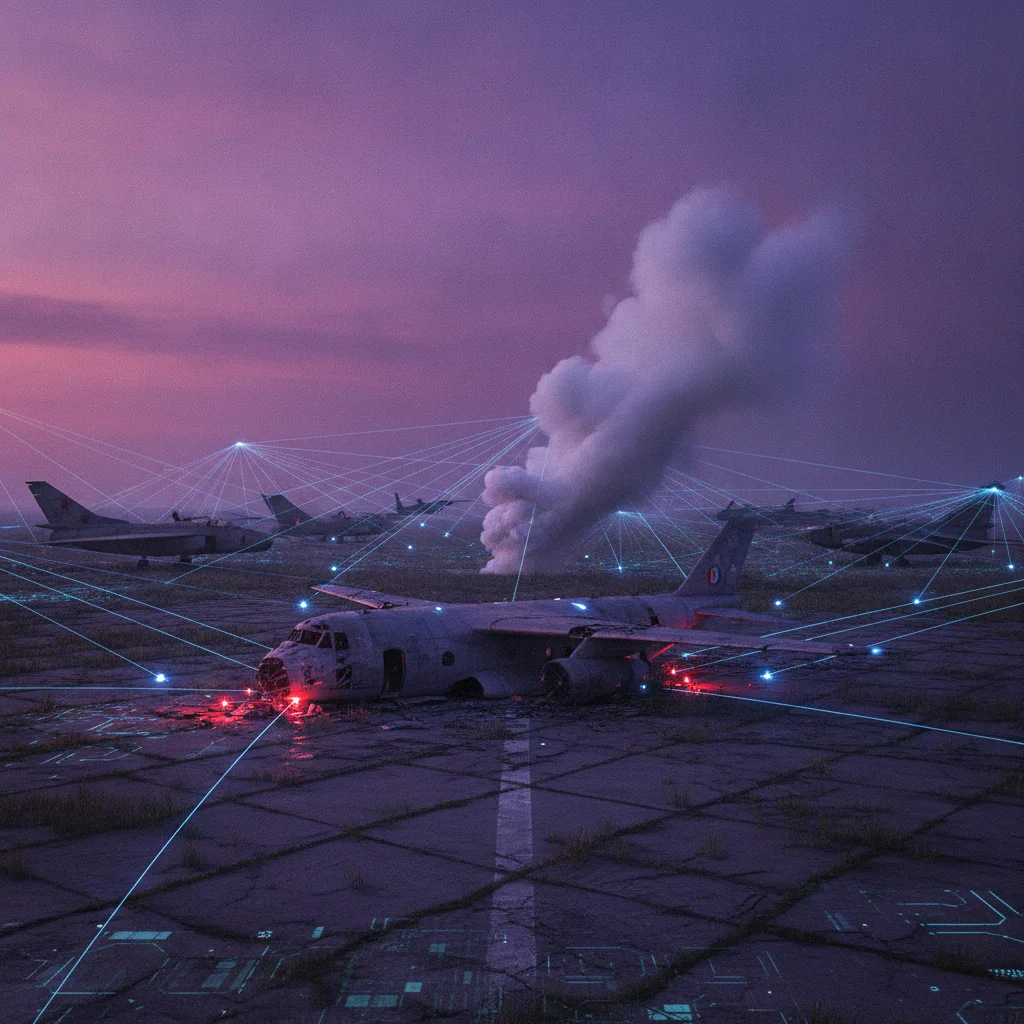
AN-32 Crash Coverage: Accident, Ageing Fleet, or Silence?
TL;DR: The June 2026 AN-32 crash at Jorhat killed five IAF personnel, including two Agniveers, and reignited two separate debates: the safety of India's ageing Soviet-era transport fleet and the Agnipath scheme's treatment of recruits who die in service. Most media coverage followed a familiar script of grief, condolence, and brief outrage before moving on. What rarely gets asked is why the AN-32 is still flying after 40 years of crashes, and why court-of-inquiry findings almost never reach the public.
On June 13, 2026, an Indian Air Force AN-32 transport aircraft caught fire while landing at the Rowriah airfield inside Jorhat Air Force Station, Assam. The aircraft broke apart on impact. Five personnel died: Squadron Leader Prashant Singh, Flight Lieutenant Shubham Kumar, Sergeant Jitendra Sharma, Agniveervayu Khemaram Kumawat, and Agniveervayu Danish Alam. The co-pilot survived and was rushed to an IAF medical facility (ThePrint).
Within hours, the news cycle had absorbed the crash. Defence Minister Rajnath Singh posted on X: "Deeply anguished by the loss of five Air Warriors in the AN-32 accident at Jorhat, Assam. Their courage and service to the nation will always be remembered with pride and gratitude" (Free Press Journal). Assam Chief Minister Himanta Biswa Sarma followed. Opposition leaders offered condolences too. A court of inquiry was constituted (ThePrint). By the next morning, most outlets had moved on.
This is the script. It plays out every time an IAF aircraft goes down. And it goes down more often than most Indians realize.
A Fleet That Keeps Falling
India procured 125 AN-32 aircraft from the Soviet Union between 1984 and 1991. These twin-engine turboprop transports were the backbone of IAF logistics, designed to haul 6.7 tonnes of cargo or 50 equipped soldiers into high-altitude airfields across the Himalayas and the Northeast (The Federal). Production happened at the Antonov plant in Kyiv between 1982 and 1996, yielding 358 units globally (Defence.in).
India still operates roughly 100 of them. The fleet has recorded more than 18 major accidents over the decades, including a 2016 crash over the Bay of Bengal that killed all 29 people aboard and a 2019 crash near Pari hills in Arunachal Pradesh that killed 13 (Wikipedia - 2016 crash; Wikipedia - 2019 crash). The wreckage from the 2016 crash was only confirmed in January 2024, nearly eight years later, when debris washed up off the coast of Chennai.
These are not isolated events. Since independence, the Indian Air Force has lost an estimated 2,869 aircraft and 1,305 pilots (The Urdu Club). The MiG-21, retired only in September 2025 after six decades of service, accounted for over 400 of those crashes, earning the grim nickname "flying coffin." The AN-32 carries its own weight in this ledger.
The Numbers No One Talks About
India's military aircraft accident rate stands at approximately 1.52 per 10,000 flying hours, significantly above the global standard range of 0.2 to 0.89 (The Urdu Club). The IAF has pointed to recent improvements, claiming a record low of 0.22 per 10,000 hours in recent years (SPS Aviation). But that number sits alongside a disturbing 2026 trend.
The Jorhat crash was not an anomaly this year. It was the fifth major incident involving IAF aircraft in 2026 alone:
| Month | Incident | Outcome |
|---|---|---|
| January | Microlight trainer forced landing near Prayagraj | Crew survived |
| February | HAL Tejas overran runway after technical malfunction | Pilot ejected safely |
| March | Su-30MKI crashed in Assam | Both pilots killed |
| April | Su-30MKI undercarriage failure at Pune | Crew survived, airport blocked 9+ hours |
| June | AN-32 crashed at Jorhat | Five killed |
That is four incidents in four months before the AN-32 even went down. Yet the pattern of coverage for each was nearly identical: breaking news alert, condolence tweets, court-of-inquiry announcement, silence.
What the CAG Found (and What the Media Didn't Amplify)
A 2017 report by the Comptroller and Auditor General found that the AN-32 fleet's serviceability rate had dropped to just 40 percent. The primary reason: critical spare parts shortages (The Federal). The problem was not new, but it was getting worse. India's reliance on Ukrainian suppliers for AN-32 components meant that the Russia-Ukraine conflict, which began in 2022, effectively choked the supply chain (Defence.in).
The spare parts crisis was not limited to the AN-32. The same CAG report found that the IL-76 heavy transport fleet had an average serviceability rate of just 38 percent, and the IL-78 tanker fleet managed 49 percent, both well below the required 70 percent (FlightGlobal). Retired IAF officers have estimated that only 50 to 55 percent of the entire IAF fleet is airworthy at any given time.
This is the context that rarely survives the news cycle. When an AN-32 crashes, the coverage focuses on the immediate tragedy: the fire, the casualties, the condolences. It does not usually linger on the institutional failures that made the crash statistically predictable.
The $400 Million Upgrade That Wasn't Enough
Following a 2009 crash, India signed a $400 million agreement with Ukraine's Antonov company to modernize the AN-32 fleet. The plan called for 40 aircraft to be refitted in Kyiv and 62 at the Base Repair Depot in Kanpur (Defence.in). Upgrades included new avionics, engine overhauls, and safety systems such as emergency locator transmitters. By 2026, roughly 55 aircraft had been modernized.
But modernizing a 40-year-old airframe has limits. The overhaul extends the aircraft's certified life to 40 years and addresses avionics and engine components, but structural fatigue and metal corrosion remain ongoing risks. At an estimated cost of 25 crore per aircraft, the upgrade is far cheaper than buying new planes, but the question is whether cheaper means safe enough.
In June 2025, the IAF announced a new programme to extend the AN-32's service life until at least 2040, this time with domestic partners under the "Aatmanirbhar Bharat" framework. The No. 1 Base Repair Depot in Kanpur would collaborate with private Indian companies to modernize at least 60 aircraft (Defence.in). Defence Minister Rajnath Singh told Parliament in early 2024 that the oldest AN-32 airframes would retire around 2032, with upgraded ones serving until 2037 to 2040.
That means India plans to keep flying some of these aircraft for another 14 years.
The Replacement That Took Two Decades
The plan to replace the AN-32 began in the mid-2000s. India and Russia discussed jointly developing a medium transport aircraft with a cargo capacity of 15 to 20 tonnes. The first flight was supposed to happen in 2013. A formal agreement was only reached in 2010. Then the project stalled (ThePrint).
On March 2, 2026, the Defence Procurement Board finally cleared the acquisition of 60 Medium Transport Aircraft under the "Buy and Make" model: 12 aircraft in flyaway condition from the original manufacturer and 48 to be manufactured in India (Overt Defense). Brazil's Embraer is offering its C-390 Millennium in partnership with Mahindra Defence.
But DPB clearance is only the beginning. The project still requires approval from the Defence Acquisition Council and the Cabinet Committee on Security before tendering, trials, negotiations, and contract signing. If past procurement timelines are any guide, the first MTA deliveries are years away.
Meanwhile, the Airbus C-295 programme is further along. India signed a deal for 56 C-295W aircraft: 16 in flyaway condition from Spain and 40 to be manufactured by Tata Advanced Systems in Vadodara, Gujarat (News on Air). The last Spanish-built C-295 was received in August 2025, and the first Indian-assembled unit is expected by September 2026. But the C-295 is a lighter aircraft, carrying up to 71 troops. It is not a direct replacement for the AN-32's heavier payload role.
The result is a gap. The AN-32 is too old to be safe. Its replacement is too slow to be ready. And the aircraft keeps flying because there is nothing else that can do its job in the terrains where India needs it most.
How Media Covers (and Doesn't Cover) Military Crashes
Defence expert Praful Bakshi, commenting on the Jorhat crash, called for Air Traffic Control to "come clean" on the circumstances. He cited possible causes including heavy landing, tyre burst, or bird hit, and noted a "worldwide tendency for ATC not to speak immediately because it does not know the direction the investigation will take" (NewKerala).
This observation captures a wider pattern. Military aviation accidents in India are investigated through internal courts of inquiry whose findings go through senior IAF officers before being finalized. The results are rarely made public. Unlike civilian aviation, where the Aircraft Accident Investigation Bureau publishes reports (however delayed), military crash investigations operate behind a wall of institutional opacity.
The media's role in this system is telling. Coverage of the Jorhat crash, like its predecessors, followed a predictable arc:
Phase 1: Breaking news. Photos and videos of smoke rising from the crash site went viral. News channels ran the visuals on loop.
Phase 2: Condolences. Political leaders posted grief statements. The fallen personnel were named and honored.
Phase 3: The "ageing fleet" angle. A day or two of analysis about the AN-32's troubled history. Expert panels. Historical crash data.
Phase 4: Silence. The court of inquiry was announced. No follow-up reporting on its progress. No accountability demanded. The story disappeared.
What is missing from this cycle is sustained investigative reporting. How many AN-32 court-of-inquiry reports have been completed and made public? What did they find? Were recommendations implemented? Did the spare parts situation improve after the 2017 CAG report? These questions require the kind of persistent journalism that does not fit neatly into a breaking news format.
Compare this to civilian aviation coverage. When Air India flight AI-171 crashed in Ahmedabad in June 2025, victims' families petitioned the Supreme Court for transparency. Relatives of 30 victims wrote directly to the Prime Minister requesting release of cockpit voice recorder data (GG2). Civil aviation minister K. Rammohan Naidu was pressed for timelines. The AAIB issued regular updates. None of this pressure exists for military crashes.
The phrase "service accident" does a lot of quiet work in this context. It positions the crash as an operational hazard, something inherent to military service, rather than a potential institutional failure. The language of sacrifice, while sincere, can also function as a shield against accountability.
The Agniveer Question
Two of the five personnel killed at Jorhat, Khemaram Kumawat and Danish Alam, were Agniveers: recruits under the government's Agnipath short-term military recruitment scheme launched in 2022. Kumawat, 22, was from Panchota village in Rajasthan's Didwana-Kuchaman district. He had joined the IAF in December 2022 and was nearing the end of his four-year tenure. His family had recently begun discussions about his marriage (Prokerala).
Under the Agnipath scheme, Agniveers serve four-year terms. They do not receive pensions. Their families are not entitled to the same benefits that families of regular military personnel receive in the event of death in service. A parliamentary standing committee on defence recommended that "after martyrdom of an Agniveer, the same benefits should be provided to their family members that are provided to the family of a regular soldier" and also recommended increasing the ex-gratia amount by 10 lakh in each category (Deccan Herald).
Opposition leaders, including Rahul Gandhi, Akhilesh Yadav, and Arvind Kejriwal, have criticized the Agnipath scheme for failing to provide long-term job security and for what they describe as diminishing the armed forces' fighting spirit (Drishti IAS).
The Jorhat crash did not start the Agniveer debate. But it sharpened it. When two Agniveers die in a crash caused (at least in part) by an ageing aircraft that should have been replaced years ago, the policy questions compound. It is no longer just about the aircraft. It is about who flies in the aircraft, on what terms, and what their families receive when things go wrong.
Most media coverage treated these as two separate stories: the crash and the Agniveer policy. Very few outlets connected the dots between a procurement system that delays fleet replacement for decades, a recruitment scheme that reduces benefits for serving personnel, and a crash that kills people at the intersection of both failures.
The Bigger Pattern: What "Service Accident" Language Conceals
India's fighter squadron strength has dropped to approximately 29 operational squadrons against an authorized requirement of 42 for credible two-front deterrence. This is the lowest Indian fighter strength in decades, falling below 1965 levels according to some assessments (Defence Security Asia).
The Tejas Mk1A programme, meant to be the backbone of indigenous fighter production, has 180 aircraft on order but deliveries are roughly two years behind schedule due to engine shortages and integration issues. HAL produces only 16 to 24 aircraft annually.
This is not a crisis that emerged overnight. It is the result of systematic procurement delays, maintenance backlogs, and a bureaucratic culture that treats defence acquisition as a process to be managed rather than a capability to be delivered. The AN-32 crash at Jorhat is one data point in this larger pattern.
But the media rarely frames it that way. Each crash is treated as an isolated event, covered in its own news cycle, disconnected from the structural failures that produced it. The "service accident" frame ensures that grief is expressed, courage is honored, and the system that enabled the crash continues undisturbed.
What Would Better Coverage Look Like?
First, sustained follow-up on court-of-inquiry outcomes. Every AN-32 crash since 2016 has been followed by a court of inquiry. How many reports have been completed? What did they recommend? Were the recommendations implemented? No Indian news outlet has systematically tracked this.
Second, data-driven accountability journalism. The CAG's 2017 findings on AN-32 serviceability were devastating. Has the rate improved since? The data exists somewhere in the defence establishment. Obtaining and publishing it would be more valuable than another panel discussion about "ageing fleets."
Third, connecting procurement delays to operational outcomes. The MTA programme has been discussed since the mid-2000s. Twenty years of delay is not just a bureaucratic failing. It is directly linked to the continued use of aircraft that are no longer safe enough to fly. Coverage that draws this line explicitly would serve the public interest far more than breaking-news visuals of smoke rising from a crash site.
Fourth, the human cost beyond condolences. The stories of Khemaram Kumawat and Danish Alam deserve more than a paragraph noting their Agniveer status. What does the Agnipath policy mean, concretely, for their families? What benefits will they receive compared to the families of the three regular-service personnel who died alongside them? These are questions that reporting, not opinion columns, should answer.
The AN-32 crash at Jorhat was a tragedy. But it was also a predictable one. The aircraft was old. The fleet was known to be under-maintained. The replacement was known to be delayed. The only surprise is that anyone was surprised.
Read TBN's full multi-source coverage of the Jorhat crash here.
Sources
- ThePrint - 5 IAF personnel including 2 Agniveers die in AN-32 crash in Jorhat, Assam - crash details, victim identification
- ThePrint - IAF orders court of inquiry into AN-32 crash - court of inquiry announcement
- ThePrint - Yet another AN-32 crash, replacement of aging fleet planned since mid-2000s - MTA programme history and delays
- Free Press Journal - Rajnath Singh expresses condolences - Defence Minister's statement
- The Federal - AN-32 crash in Assam: What ails the Soviet-era military jet? - fleet history, CAG report, maintenance challenges
- Defence.in - IAF's AN-32 to fly until 2040 with indigenous overhaul - upgrade programme details
- Defence Security Asia - India's Fourth Air Force Incident in 2026 - multiple 2026 incidents, squadron strength crisis
- Overt Defense - IAF Medium Transport Aircraft programme - DPB clearance, procurement model
- The Urdu Club - Indian Air Force Plane Crashes 1947-2026 - historical crash statistics
- SPS Aviation - IAF Records Lowest Ever Accident Rate - IAF safety improvements
- News on Air - First C-295 MW formally inducted into IAF - C-295 programme
- Wikipedia - 2016 Indian Air Force AN-32 crash - 2016 crash details
- Wikipedia - 2019 Indian Air Force AN-32 crash - 2019 crash details
- NewKerala - IAF Aircraft Crash: Expert Seeks ATC Clarity - expert analysis on ATC accountability
- Deccan Herald - Regular benefits should be given to families of Agniveers - parliamentary panel recommendations
- Prokerala - Rajasthan's Agniveer Khemaram martyred in Assam crash - Agniveer background
- Drishti IAS - Agnipath Scheme - opposition criticism
- GG2 - Air India crash report still pending one year after AI-171 disaster - civilian aviation transparency comparison
- FlightGlobal - Indian report slams IL-76 availability rate - CAG findings on broader fleet serviceability
- TBN Coverage - IAF AN-32 Crash at Jorhat - multi-source balanced coverage