DMK Skips INDIA Bloc Meet: How Media Frames Opposition 'Unity'
TL;DR
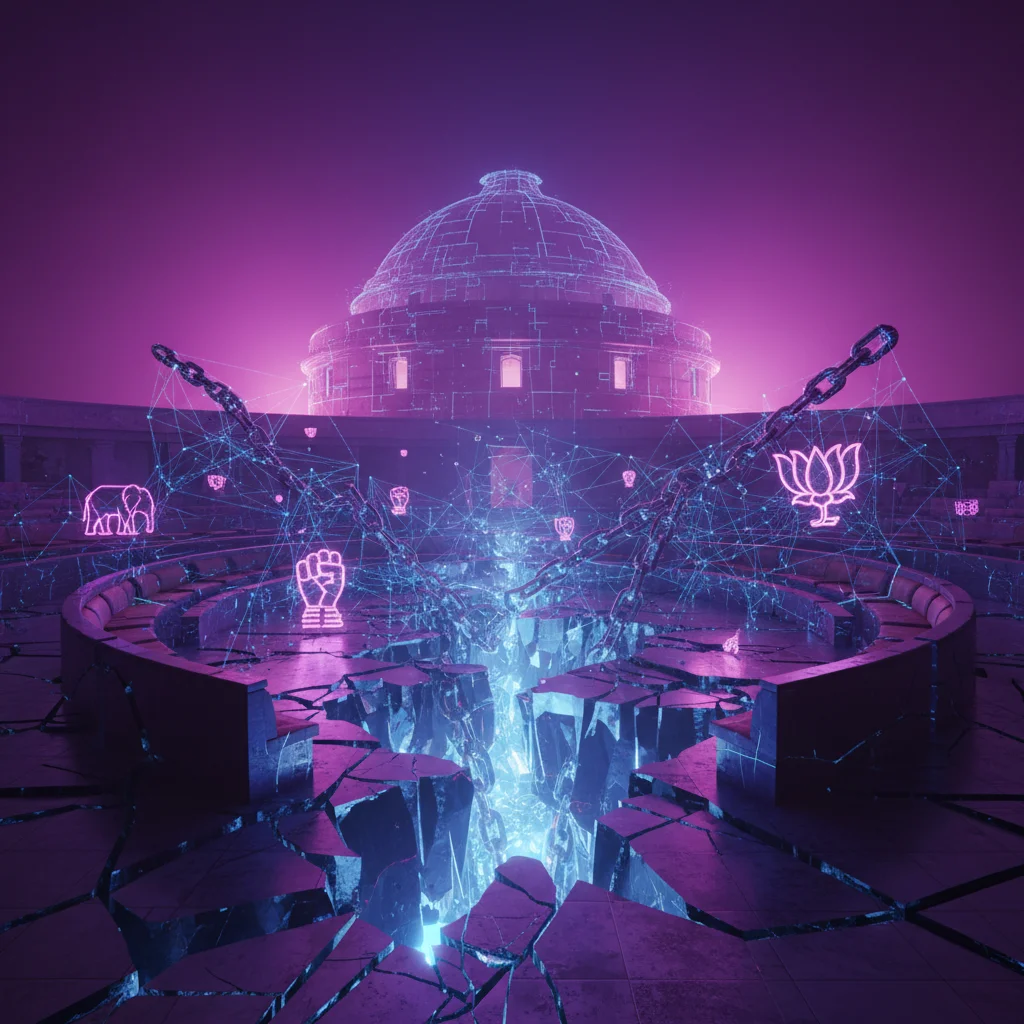
The DMK's decision to boycott the June 8 INDIA bloc meeting after Congress backed the TVK government in Tamil Nadu is real. But depending on which outlet you read, it's either proof that India's opposition is permanently finished, a temporary lovers' quarrel, or evidence that Congress is incapable of leading anything. The facts are secondary to the frame, and the frame tells you more about the outlet than about the DMK.
On June 4, 2026, the DMK confirmed what had been brewing for a month: it would not attend the INDIA bloc coordination meeting scheduled for June 8 at the Constitution Club in New Delhi. The reason was straightforward. The Congress, which won five seats contesting under the DMK-led Secular Progressive Alliance in Tamil Nadu's April 2026 assembly elections, had switched sides to support the TVK-led government of actor-turned-politician C. Joseph Vijay.
Within hours, Indian media had the story. But which story? That depends entirely on where you looked.
What Actually Happened in Tamil Nadu
The 2026 Tamil Nadu Assembly election was historic by any measure. The Tamilaga Vettri Kazhagam (TVK), a party founded just two years earlier, won 108 of 234 seats in a state where power had alternated between the DMK and AIADMK for 59 unbroken years. Voter turnout hit 85.1%, the highest in the state's history. The DMK was reduced to 59 seats. The AIADMK got 47. Congress won five. The BJP scraped one.
Tamil Nadu had its first-ever hung assembly. The full breakdown told the story of a fractured electorate: TVK 108, DMK 59, AIADMK 47, INC 5, PMK 4, IUML 2, VCK 2, CPI 2, CPI(M) 2, BJP 1, and a handful of smaller parties splitting the rest (ECI results).
TVK fell 10 seats short of the 118 needed for a majority. What followed was a scramble for support that would reshape alliances at both the state and national level. Within days of the results on May 4, Congress broke away from the DMK-led alliance and extended support to Vijay's government. Along with Congress, four other Secular Progressive Alliance partners, including the CPI(M), CPI, VCK, and IUML, also switched. With 120 MLAs behind him, Vijay was sworn in as Tamil Nadu's ninth Chief Minister on May 10.
The speed of Congress's switch stung the DMK most. This was not a party that had deliberated for weeks. It moved within days, reportedly securing a Rajya Sabha seat under TVK's quota as part of the arrangement, having previously held one under the DMK's.
MK Stalin, who lost his own Kolathur seat after winning it three consecutive times, resigned as Chief Minister on May 5. It was the first time a sitting DMK Chief Minister had lost a personal election.
For the DMK, Congress's switch was not just politically damaging. It was personal. The two parties had been allies for over 22 years. In the 2024 Lok Sabha elections, the DMK-Congress alliance swept all 40 seats in Tamil Nadu and Puducherry with a combined 52% vote share. The DMK currently holds 22 Lok Sabha seats. It was one of the INDIA bloc's most reliable anchors.
The Language of Rage
The DMK's response has been unsubtle. At a party meeting in Chennai, DMK Youth Wing Chief Udhayanidhi Stalin declared: "For over 20 years, the Congress party rode on our backs. Today, they have stabbed us in the back. No one should ever forget this."
He went further: "I thought Modi and Amit Shah were the reasons for the BJP's victory across India. But it is evident now that the Congress is the reason for the BJP's rise in India" (PGurus).
Party resolutions passed at the DMK meeting reportedly described Congress as "backstabbers" and "leeches" surviving on the hard work of alliance partners.
The fallout spilled into Parliament. On May 7, DMK parliamentary party leader Kanimozhi Karunanidhi wrote to Lok Sabha Speaker Om Birla, requesting separate seating for DMK MPs: "In view of the changed political circumstances and as our alliance with the Indian National Congress has come to an end, it may not be appropriate for our members to continue occupying the present seating arrangement alongside them in the House" (India TV News). The Lok Sabha Secretariat approved the request.
Former CM MK Stalin, for his part, compared public enthusiasm for the Vijay-led government to "children losing interest in a new toy," predicting it would not complete its five-year term.
These are strong words. But media coverage of them reveals as much about the outlets as about the DMK's emotions.
The Right-Wing Frame: 'Opposition Is Dead'
For pro-BJP and right-leaning outlets, the DMK boycott arrived like a gift. It confirmed a narrative they have been building for years: that the INDIA bloc is a dysfunctional, opportunistic coalition that was never meant to last.
Organiser, the RSS's official publication, ran the headline "Tamil Nadu DMK says no to INDIA alliance meet in Delhi, blames Congress for political backstabbing." The emphasis is on Congress's failure, cast not as a one-time mistake but as a character flaw. The framing positions the INDIA bloc's internal crisis as inherent rather than situational.
NewsX called it a "setback for opposition unity push," framing the boycott as a decisive blow rather than a negotiation tactic.
PGurus amplified the DMK's most inflammatory language, headlining with "Backstabbers, leeches," which serves a dual purpose: it makes the DMK look extreme while making Congress look weak.
The pattern is consistent. Right-leaning outlets rarely interrogate why Congress switched sides. They don't ask whether TVK's rise represents a legitimate democratic shift. They don't explore the structural incentives that push parties toward power-sharing in hung assemblies. Instead, the entire episode is reduced to evidence of opposition incompetence.
This framing has a context. India's media landscape has shifted significantly since 2014. The term "godi media", coined by veteran journalist Ravish Kumar, describes outlets perceived as functioning as government mouthpieces. Reporters Without Borders ranked India 157th out of 180 countries in its 2026 Press Freedom Index, citing the rise of such outlets. In this environment, opposition fractures get amplified. Opposition coordination gets ignored.
The Left-Liberal Frame: 'Congress Blew It'
Left-leaning and liberal outlets tell a different story. Here, the DMK is not unreasonable. Congress is the villain.
The South First focused on the word "betrayal," centering the DMK's grievance and providing extensive context on the 22-year alliance. The implicit message: Congress sacrificed a reliable, long-standing partner for short-term power in a government that may not survive.
Countercurrents took the opposite angle from Organiser, framing the June 8 meeting as a signal of "reconciliation and strategic renewal." The argument: coalition differences are inevitable, and what determines viability is the ability to resolve them. The DMK boycott is a negotiating position, not a death warrant.
This framing also has blind spots. It tends to downplay the DMK's own strategic calculations. The DMK is not merely an aggrieved partner. It is a party that lost power, lost its leader's own seat, and now faces a political landscape in Tamil Nadu where its 59-year dominance is over. Some of its anger at Congress is genuine. Some of it is positioning for a post-Congress opposition future. Left-liberal outlets often conflate the two because the first narrative is sympathetic and the second is complicated.
There is also a tendency in this framing to treat the DMK as a passive victim. But the DMK's alliance history is not one of unwavering loyalty. The party allied with the BJP in the 1999 elections, winning 26 seats as part of the NDA coalition. It returned to Congress for the 2004 polls and then withdrew from the UPA government in 2013 over the Sri Lankan Tamils issue. The DMK has always operated on the principle that alliances serve state-level interests first. That Congress did the same thing in 2026, to the DMK's detriment, is what makes the "betrayal" narrative asymmetric.
The Centrist Wire Frame: 'Rift Deepens'
Wire services and centrist outlets take a third approach. They report the facts, but their framing vocabulary is revealing.
India TV News ran a headline that has become the default template for this kind of story: "DMK-Congress rift deepens." The word "deepens" implies a trajectory without assigning blame. It suggests inevitability without explaining causation.
Indian News Network focused on the June 8 meeting's agenda, mentioning the DMK boycott almost as an aside. The Delimitation Bill, which requires a constitutional amendment the BJP cannot pass without a two-thirds majority, is framed as the real story. The DMK drama is context, not content.
This approach has its own problems. By treating every development as a data point on a trajectory, centrist framing can make political crises feel inevitable and therefore unimportant. The reader learns what happened but not what it means.
The "rift deepens" formula is especially misleading because it implies a linear progression. In Indian coalition politics, rifts open and close depending on electoral arithmetic. The DMK itself has gone from ally to rival to ally with both Congress and the BJP over the past three decades. The word "deepens" suggests things are getting worse and will continue getting worse. The reality is murkier. These things can reverse in a single election cycle if the numbers demand it.
The Uncomfortable Questions Nobody Is Asking
Across all three frames, certain questions go largely unasked.
Why did Congress switch? The standard answer is opportunism. But Congress's calculation in Tamil Nadu was not irrational. The party won five seats. In a hung assembly, those five seats gave it leverage it would never have had in opposition. By joining the TVK government, Congress secured a seat at the table, including reportedly gaining a Rajya Sabha seat under TVK's quota. For a party that governs just four of India's 28 states independently, every foothold matters. No outlet, left or right, has seriously examined whether Congress's decision was strategically defensible even if morally questionable.
Is the INDIA bloc actually an alliance? Senior journalist Neerja Chowdhury has noted the bloc was "never designed to function as a permanent, ideological coalition" but was rather "a strategic convergence for a specific electoral moment." Political commentator Rasheed Kidwai calls it "a broad political grouping, not a structured electoral alliance, with no clear leadership". If the INDIA bloc was always a temporary arrangement, then framing its every stress fracture as a "crisis" is misleading. But calling it what it is, a loose coordination mechanism, doesn't make for urgent headlines.
What happens when the DMK stops being angry? The DMK has not announced a formal exit from the INDIA bloc. It says it will continue to "raise its voice on issues affecting the welfare of the nation." This is diplomatic language for: we're keeping our options open. If the Delimitation Bill comes to a vote, or if the BJP pushes another contentious measure, the DMK's 22 Lok Sabha MPs will be needed. The question is whether Congress can rebuild that bridge or whether the DMK follows the AAP's path of permanent estrangement.
The Structural Problem Media Won't Name
Professor Kartikeya Batra of Azim Premji University has observed that "alliances cannot be engineered purely on numbers, they require a political chemistry that simply doesn't exist in many states". Former Congress leader Sanjay Jha argues the bloc must transition from "a coalition against something to a coalition for something".
Both observations are correct. But they also reveal a structural problem that Indian media rarely names directly: Congress is simultaneously the INDIA bloc's largest national party and its biggest liability. In Tamil Nadu, Congress prioritized its own survival over alliance loyalty. In West Bengal, Congress's weakness let the BJP win. In Delhi, Congress's vote share exceeded the winning margin in 14 constituencies without winning a single seat, effectively functioning as a spoiler.
The INDIA bloc's problem is not that the DMK is upset. Regional parties have always cycled through alliances based on state-level incentives. The problem is that Congress cannot promise its allies two things they need: electoral viability in their states and policy consistency at the national level.
Consider the track record. Congress governs just four of India's 28 states independently and is a junior partner in two others. The BJP, by contrast, governs 16 on its own and five with coalition partners. In Tamil Nadu, Congress joined a government that may not last. In West Bengal, Congress was too weak to prevent the BJP from winning for the first time. In Delhi, Congress won zero seats but received enough votes to exceed the winning margin in 14 constituencies, effectively functioning as a spoiler for AAP without gaining anything itself.
For regional parties evaluating whether to stay in the INDIA bloc, the question is increasingly simple: what does Congress bring to this table? Electoral support in their states? Not reliably. National policy coherence? Not demonstrably. A credible path to defeating the BJP? The 2024 Lok Sabha results offered a flash of hope, but the subsequent state elections erased it.
Until that changes, every opposition "unity" meeting will be one Tamil Nadu, one West Bengal, or one Delhi away from another media cycle of "rift deepens."
What Readers Should Watch For
The June 8 meeting will happen. Rahul Gandhi, Mallikarjun Kharge, Mamata Banerjee, Uddhav Thackeray, and Akhilesh Yadav will be present. The DMK and AAP will not. The coverage will follow the usual lanes.
Right-leaning outlets will declare the bloc dead. Left-liberal outlets will call for Congress introspection. Wire services will note that the rift continues.
But the actual story will be in the details that don't make headlines. Did Congress reach out to Stalin before the meeting? Did the DMK coordinate with the TMC on shared grievances? Did anyone at the meeting discuss a concrete mechanism for resolving alliance disputes rather than papering over them?
If the answer to all three is no, then the INDIA bloc's problem is not media framing. It's that the coalition has no internal process for dealing with exactly the kind of conflict it just experienced. And no headline, from any outlet, will fix that.
The next time you read a story about the INDIA bloc falling apart, or holding together, or being at a crossroads, ask yourself one question: is this article telling me what happened, or is it telling me how to feel about what happened? The answer will tell you more about the outlet than about Indian opposition politics.
Sources
- Election Commission of India, Tamil Nadu 2026 Party-Wise Results - Official seat tally
- Wikipedia, 2026 Tamil Nadu Legislative Assembly Election - Turnout, government formation details
- Wikipedia, Dravida Munnetra Kazhagam - 2024 Lok Sabha sweep, alliance history
- The South First, DMK to Skip INDIA Bloc Meeting - DMK statement, 22-year alliance, Kanimozhi letter
- India TV News, DMK-Congress Rift Deepens - Rift reporting
- India TV News, DMK Secures Separate Seating in Lok Sabha - Lok Sabha seating change
- India TV News, INDIA Bloc Leaders to Meet June 8 - Meeting details
- Oneindia, DMK to Skip INDIA Bloc Meeting - DMK not formally leaving bloc
- Daily Pioneer, Udhayanidhi Stalin Accuses Congress - "Stabbed in the back" quote
- PGurus, Backstabbers Leeches DMK Lashes Out - DMK resolution language, Udhayanidhi quotes
- Organiser, DMK Says No to INDIA Alliance - RSS outlet framing, MK Stalin quote, Rajya Sabha detail
- NewsX, DMK to Skip June 8 Meeting - "Setback for unity push" framing
- Outlook India, INDIA Bloc's Contradictions - Expert quotes (Chowdhury, Kidwai, Batra, Jha)
- Countercurrents, June 8 Meeting Signals Reconciliation - Optimistic counter-frame
- Indian News Network, INDIA Bloc Strategy Discussion - Meeting agenda, Delimitation Bill
- Wikipedia, Godi Media - RSF ranking 157/180, media landscape
- WSWS, BJP Makes Gains - Congress governs 4 of 28 states