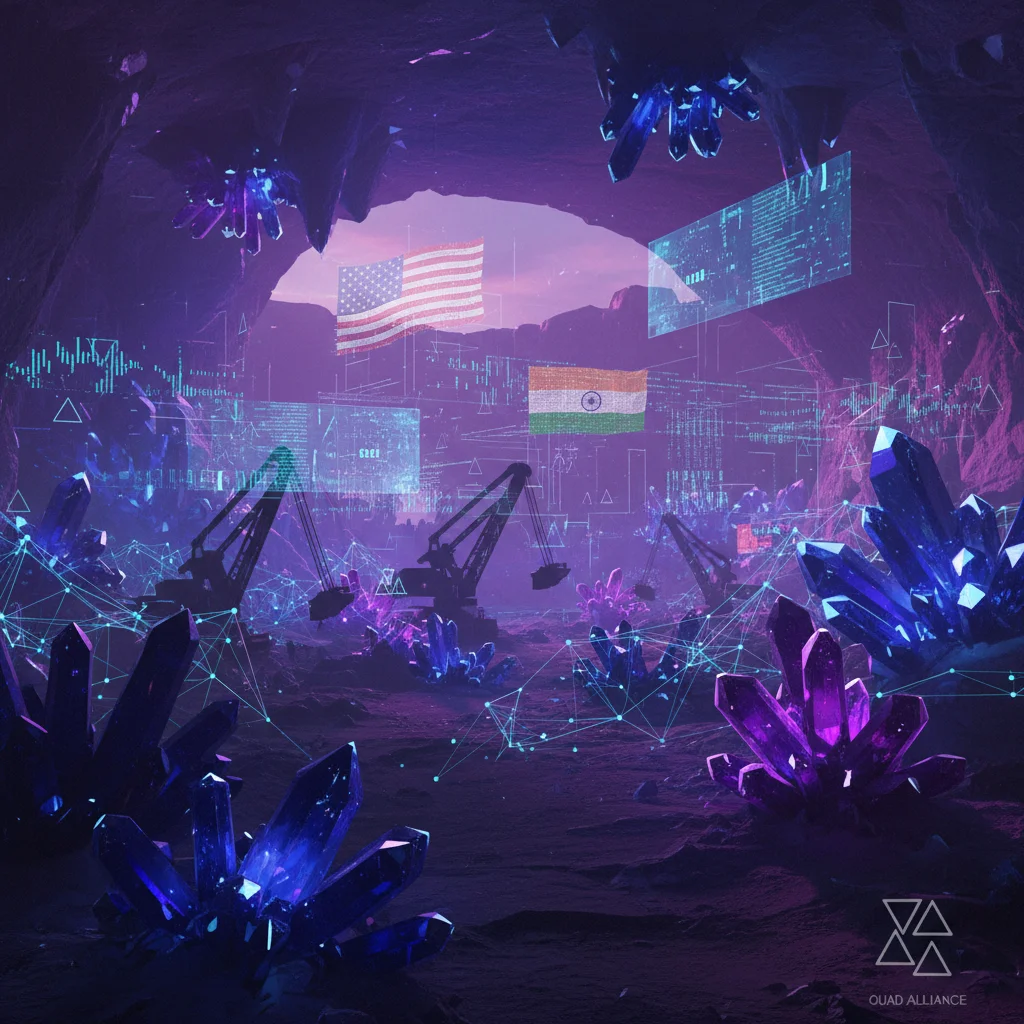
India's Critical Minerals Deal with the US: Strategy Beyond China
TL;DR: India and the US signed a framework on critical minerals and rare earths on May 26, 2026, aiming to break China's stranglehold on the supply chain. The deal is real and strategically significant. But India currently produces less than 1% of global rare earth output despite holding 6-7% of reserves, and most of its mineral diplomacy remains stuck at the MoU stage. The framework is a necessary first step, not a solution.
On May 26, India's External Affairs Minister S. Jaishankar and US Secretary of State Marco Rubio signed the "Framework on Securing of Supply in the Mining and Processing of Critical Minerals and Rare Earths" in New Delhi. The signing happened on the sidelines of the Quad Foreign Ministers' meeting, and it wasn't the only mineral deal on the table that day. The Quad nations collectively announced a $20 billion critical minerals initiative spanning mining, processing, and recycling.
Headlines framed it as India and the US joining forces against China. That framing isn't wrong, but it's incomplete. The real story is about whether India can turn its vast mineral reserves into actual production, and whether signing frameworks translates into anything more than photo opportunities.
Why This Deal Exists: China's Mineral Leverage
To understand why Rubio flew to New Delhi to sign a minerals pact, you need to understand what happened in 2025.
In April 2025, China imposed export controls on seven heavy rare earth elements, including samarium, gadolinium, terbium, dysprosium, lutetium, scandium, and yttrium. The move was a response to escalating US tariffs, but the impact went far beyond bilateral trade. Carmakers in the US, Europe, and elsewhere struggled to obtain permanent magnets. Some were forced to cut production or temporarily shut down factories.
The numbers tell the story. Chinese customs data show the US imported just 17 tons of yttrium in eight months between April and December 2025, compared to 333 tons in the preceding eight months. Even after partial normalization in early 2026, February exports were 20 tons, still 70% below January 2025 levels.
Then came Wave 2 in October 2025, extending controls to five more elements, processing equipment, technology documentation, and the technical know-how required to operate refining facilities. Beijing even asserted extraterritorial jurisdiction, claiming licensing authority over Chinese-origin materials reprocessed anywhere in the world.
While China agreed to suspend the October controls for one year at the APEC summit in Busan, the April controls remain fully in force. European rare earth prices reached up to six times Chinese domestic prices. The message was unmistakable: China's mineral dominance isn't merely a trade statistic or a market share number. It's a weapon with real-world consequences for factories and supply chains.
The underlying numbers are stark. China controls roughly 60% of global rare earth mining and processes about 90% of global supply. For 12 critical minerals, the US relies entirely on imports. For 29 more, it imports at least half. India is 100% import-dependent on lithium, cobalt, and nickel, the minerals that power electric vehicles and energy storage.
"Vibrant innovation economies such as ours cannot afford to leave the foundational materials of these industries vulnerable to a single-source monopoly that could deny us these things as a leverage point contrary to our sovereign national interests," Rubio said at the signing ceremony.
What the Framework Actually Covers
The bilateral framework covers the entire supply chain: mining, processing, refining, recycling, joint financing, and investment cooperation. It targets minerals like lithium, cobalt, nickel, graphite, and rare earth elements, materials essential for electric vehicles, semiconductors, renewable energy systems, and defence manufacturing.
One significant detail: about 80% of the critical minerals on the US strategic list overlap with India's list. This alignment is unusual in bilateral deals and enables cooperation on joint exploration in resource-rich regions, particularly Africa.
The deal isn't isolated. It fits into a larger US-led architecture that has been taking shape through 2026:
| Initiative | Date | Scope |
|---|---|---|
| Pax Silica | Feb 2026 | AI-focused supply chain security; India joined as partner |
| FORGE | Feb 4, 2026 | Plurilateral minerals coalition with 55 nations, price floors, anti-dumping tariffs |
| India-US Bilateral Framework | May 26, 2026 | Full supply chain cooperation on critical minerals and rare earths |
| Quad Critical Minerals Initiative | May 26, 2026 | $20 billion mobilization across India, US, Japan, Australia |
FORGE, the Forum on Resource Geostrategic Engagement, is particularly interesting. Launched by Rubio at a Critical Minerals Ministerial with 55 foreign delegations, it replaces the Minerals Security Partnership with what the Atlantic Council describes as "sharper teeth." US Vice President JD Vance framed it as a "preferential trading zone for critical minerals" with enforceable price floors designed to counter Chinese dumping, a practice where Beijing exports minerals at below-market prices to undercut competitors.
The US government has backed this architecture with money. According to CSIS, the Trump administration has committed over $7.3 billion across five agencies for critical minerals, including a $400 million equity stake in MP Materials and a $110 per kilogram price floor for neodymium-praseodymium output, guaranteed for 10 years.
India's Mineral Paradox: Reserves Without Production
Here is where the gap between ambition and reality becomes visible.
India ranks third globally in rare earth resources, according to USGS Mineral Commodity Summaries. The country holds 13.15 million tonnes of monazite, a phosphate mineral containing an estimated 7.23 million tonnes of rare earth oxides. The Geological Survey of India has identified an additional 482.6 million tonnes of rare earth ore resources through 34 exploration projects. Hard-rock deposits in Gujarat and Rajasthan hold 1.29 million tonnes of in-situ REO.
But production is negligible. India's actual rare earth output in 2024 was just 2,900 tonnes, less than 1% of global production. The US International Trade Administration notes that India currently produces only four critical minerals: copper, graphite, phosphorous, and titanium.
Why the gap? Monazite is classified as a "prescribed substance" under the Atomic Energy Act because it contains radioactive thorium and uranium. This places mining and processing under strict government control, which has historically throttled commercial extraction. India's monazite also predominantly contains light rare earth elements; heavy REEs, the ones most critical for magnets and defence applications, aren't available in economically extractable quantities from these deposits.
India's import dependency tells the rest of the story. The country imports 100% of its lithium, cobalt, and nickel. Chile is India's largest critical minerals supplier, accounting for 2.8 million tonnes of imports between FY19 and FY25, driven largely by copper ore. For cobalt, Finland supplied 59.77% of India's imports in FY25, a level of concentration that creates its own vulnerability. An IEEFA briefing from April 2026 warned that India's import landscape remains "structurally concentrated across a narrow set of supplier countries, amplifying supply risks."
India's Domestic Push: Policy Catching Up
To its credit, the Indian government has ramped up mineral policy since 2023. The National Critical Minerals Mission (NCMM), launched in 2025, allocates INR 16,300 crore (approximately $1.9 billion) over seven years. It targets domestic production of at least 15 critical minerals, acquisition of 50 mining assets worldwide, and 1,200 exploration projects by the Geological Survey of India through 2031.
The 2026-27 Union Budget introduced "rare earth corridors" in Odisha, Kerala, Andhra Pradesh, and Tamil Nadu, creating dedicated hubs for mining, processing, research, and manufacturing rare earth permanent magnets. A 'Scheme to Promote Manufacturing of Sintered Rare Earth Permanent Magnet', approved in November 2025, targets 6,000 metric tonnes per annum of integrated manufacturing capacity with a Rs 7,280 crore outlay.
The country's first tailings policy, announced in January 2026, creates guidelines for extracting critical minerals from mine dumps and existing mine waste. In May 2026, Union Minister G. Kishan Reddy formalized mission-mode functioning across four central institutions, including GSI and the Indian Bureau of Mines.
Internationally, India's KABIL consortium (NALCO, HCL, and MECL) is pursuing mining assets abroad. KABIL signed an agreement with Argentina's CAMYEN SE in January 2024 for lithium exploration covering 15,703 hectares in Catamarca province.
The Uncomfortable Math
All of this policy action still doesn't close the gap, and the gap is growing faster than the response.
India's lithium-ion battery demand was roughly 10 GWh in 2024. UC Davis projections suggest this could surge to 422 to 698 GWh by 2040. Annual mineral demand would need to rise to 1,075 to 1,777 kilotons, a 46 to 66 times increase from 2024 levels. Even scaling to 100 GWh of domestic battery manufacturing would meet only 14-24% of 2040 mineral requirements.
Mining projects typically require 8 to 16 years from exploration to production. India's ambitious exploration targets under NCMM run to 2031. Even if they succeed on schedule, commercial production at scale is a 2030s story at best.
And the diplomatic pipeline has a track record problem. A review of Ministry of Mines Annual Reports from 2020 to 2026 shows that most international mineral engagements remain at the MoU level, "with only a limited number progressing to project-level evaluation, and even fewer to concrete exploration." As The Diplomat's analysis put it: "Partnerships do not equal supply security."
There is also a structural question about what problem this solves. India currently imports 85% of its crude oil, making it deeply vulnerable to geopolitical shocks in the energy market. India's clean energy targets include 30% EV share by 2030, 500 GW of non-fossil energy capacity, and 60% non-fossil capacity by 2035. Achieving these will reduce exposure to oil import shocks, but it replaces one dependency with another: from fuel to battery minerals. Without domestic production of clean energy technologies, including battery cells, the mineral demand won't directly accrue to India. It will arrive embedded in imported cells and components, adding layers of complexity to supply chain risk management rather than eliminating the vulnerability.
How Indian Media Is Covering This
TBN tracked 40 sources covering this story (see the full coverage), and the framing patterns are instructive.
Right-leaning outlets like Organiser and Republic World emphasize the anti-China dimension and India's rising strategic clout. The deal is positioned as validation of India's global standing and a vindication of the Modi government's "multi-alignment" foreign policy. Coverage in these outlets leans heavily on official statements and frames the framework as a near-equal partnership.
International outlets like Al Jazeera and Scroll provide more context about India's production gaps and the scale of China's dominance. The Diplomat asks whether diplomacy alone can deliver results, pointing to the gap between MoUs signed and mines opened. These outlets are more likely to quote analysts and include caveats about implementation timelines.
Almost no Indian outlet mentioned that the US signed a $1.25 billion investment in Pakistan's Reko Diq mining project in December 2025, or that the US has 11 bilateral mineral frameworks with other countries signed in February alone. The US also made a $50 million equity investment in a South African rare earths project in April 2026, and the Export-Import Bank has issued nearly $4 billion in letters of intent across the rare earth supply chain globally. India's deal is one piece of a much larger US puzzle. Framing it as an exclusive bilateral partnership misses that context entirely.
What Should You Watch For?
Three things will determine whether this framework produces results or joins the growing pile of strategic MoUs:
First, processing capacity. Mining is only the beginning. China's dominance isn't primarily about what's in the ground; it's about 85-90% control of global refining and processing capacity. India's rare earth corridors need to build processing infrastructure, not just extraction. The permanent magnet manufacturing scheme is a step in this direction, but 6,000 tonnes per year is a small fraction of global demand.
Second, the November 2026 deadline. China's suspension of its October 2025 export controls expires in November 2026. If Beijing reinstates them, the urgency for alternative supply chains intensifies overnight. If it extends the pause, political momentum for expensive diversification projects could stall.
Third, the DOD sourcing deadline. The US Department of Defense has implemented strict sourcing requirements barring rare earth materials from China, Russia, Iran, and North Korea by January 1, 2027. Whether this deadline holds or gets pushed back will signal how serious the US is about decoupling.
India's mineral diplomacy is real, well-timed, and strategically sound. The US-India framework, the Quad's $20 billion commitment, India's domestic NCMM investments, and the rare earth corridor policy represent the most coordinated push India has ever made on critical minerals. But as one analysis put it, "Mineral diplomacy cannot be disconnected from domestic industrial policy." The US Embassy statement that Washington and New Delhi will "engage in international efforts to protect sensitive supply chains from coercive market practices" is aspirational language. The framework exists. Now comes the harder part: turning rock into supply chains, MoUs into mines, and strategic intent into actual tonnes of processed rare earth magnets leaving Indian factories.
Sources
- Al Jazeera — India, US strike critical minerals deal: What's in it, why does it matter? — Deal overview, China dominance stats, India's reserves
- CSIS — Rare Earth Export Restrictions One Year Later — Yttrium trade data, US investment, price floors, DOD deadline
- The Diplomat — Can Diplomacy Alone Secure India's Critical Minerals Future? — Battery demand projections, MoU-to-project gap, counter-perspective
- Atlantic Council — US critical minerals policy goes collaborative with FORGE — FORGE structure, Vance quote, anti-dumping design
- Free Press Journal — India Signs Critical Minerals Framework With US — 80% list overlap, US Embassy quote
- Organiser — Quad $20B for critical mineral chain — Quad initiative, investment structure
- Republic World — India-US Strike Critical Minerals Deal — Deal details, strategic context
- S&P Global — Rare earth supply bottlenecks set to persist in 2026 — October 2025 controls, processing bottleneck
- PIB — National Critical Mineral Mission — NCMM budget, exploration targets
- PIB — India's Rare Earth Strategy — Permanent magnet scheme, USGS ranking
- Down to Earth/IEEFA — India's critical mineral imports remain highly concentrated — Chile imports, Finland cobalt dependency
- US State Department — 2026 Critical Minerals Ministerial — FORGE launch, 55 delegations
- CNBC — US calls for trade bloc to counter China's leverage — Pax Silica context
- DD News — India has 8.52 million tonnes reserves of REE — India REE production 2,900 tonnes
- Organiser — India's rare earth resources — GSI exploration, hard-rock deposits
- Rare Earth Exchanges — India's Monazite Moment — Atomic Energy Act restrictions, heavy REE gap
- Business Standard — Centre announces India's first tailings policy — January 2026 tailings policy
- Discovery Alert — G Kishan Reddy's mission-mode push — May 2026 institutional reforms
- IBEF — Critical Mineral Imports and India's Green Energy Transition — KABIL consortium
- IEA — National Critical Mineral Mission policy summary — KABIL Argentina agreement
- Scroll — India, US sign critical minerals deal — China export controls context
- IBG News — Quad Nations Launch $20 Billion Critical Minerals Initiative — Quad initiative details