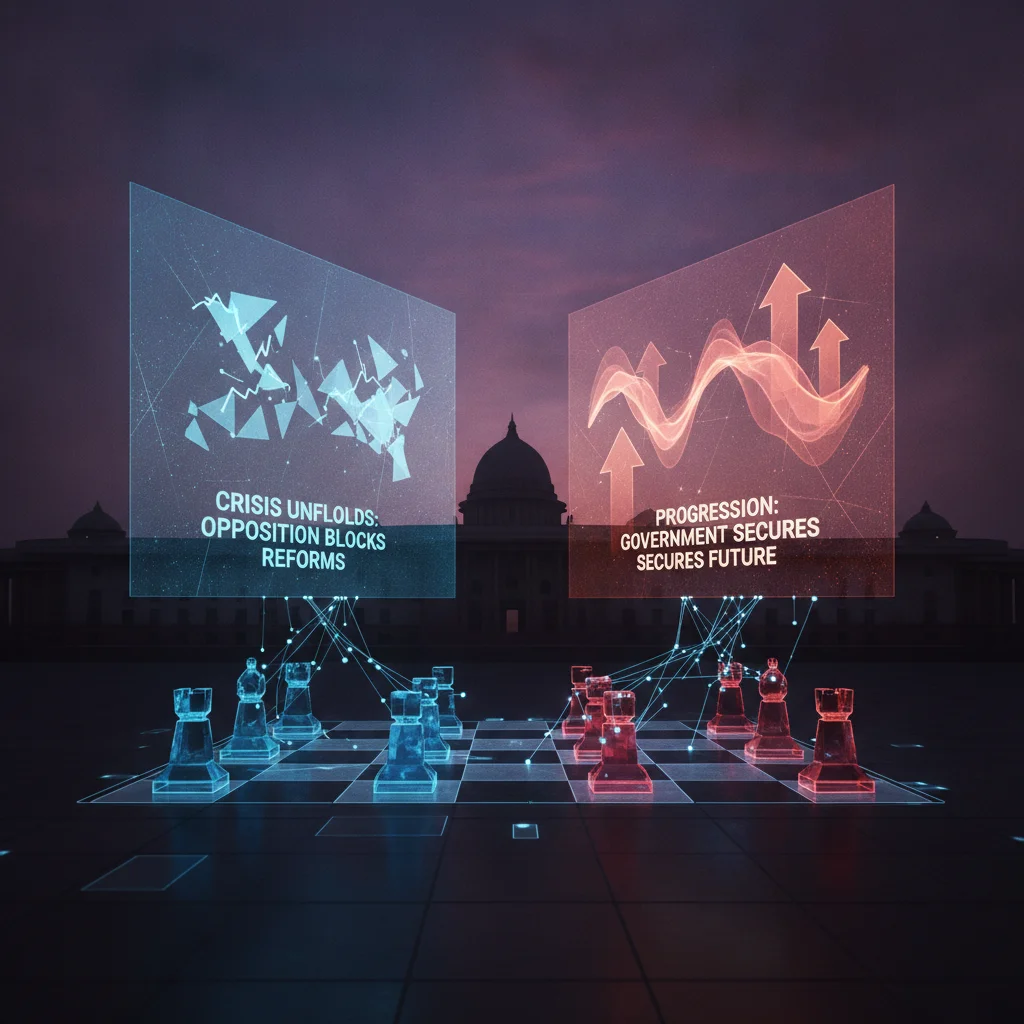
Why Politician Resignations Are Framed as 'Crisis' or 'Courage'
TL;DR: When politicians leave the TMC or Congress, headlines scream "crisis" and "blow." When they join the BJP, the same move becomes a "homecoming" or "bold decision." The language Indian media uses to describe party-switching reveals more about editorial alignment than about the politicians themselves. Here is what the pattern looks like, why it matters, and what readers should watch for.
On June 10, 2026, Trinamool Congress MP Sushmita Dev resigned from the Rajya Sabha. Within minutes, she was photographed smiling alongside Assam Chief Minister Himanta Biswa Sarma in Delhi. The pictures told one story. The headlines told several.
The Print led with her quote: "Did not want to be in two boats." Economic Times ran: "Sushmita Dev resigns from Rajya Sabha, second TMC setback in a week." Times Now went bigger: "Another Blow To Didi? Sushmita Dev's Revelations Add Fuel To TMC Defection Storm." OneIndia, a right-leaning outlet, declared flatly: "TMC MP Sushmita Dev Resigns, Likely To Join BJP."
Notice the pattern. Every headline frames the resignation as something happening to the party she left, not something happening to the party she is joining. The TMC is in "crisis." The BJP is not acquiring a new member. It is simply the gravitational force that exists in the background.
This framing is not accidental. And it is not limited to one resignation in June 2026.
The Language of Leaving vs. Arriving
Indian media has developed a remarkably consistent vocabulary for political defections, and it splits cleanly depending on direction.
When a politician leaves an opposition party for the BJP, the dominant words are: blow, setback, crisis, turmoil, implosion, exodus, rebellion. The story is told from the perspective of the party losing members. The departing politician is a symptom of the party's disease.
When the same politician arrives at the BJP, the vocabulary shifts. Homecoming, bold move, new chapter, fresh start, pragmatic decision. The story is now told from the perspective of the joining politician's individual agency. They made a choice. They saw the light.
The Balanced News tracked 72 articles covering Sushmita Dev's resignation alone. The bias breakdown: 58% of coverage came from left-leaning outlets, 31% from centrist sources, and just 11% from right-leaning ones. This imbalance itself is revealing. Left-leaning outlets covered the story aggressively because the framing suited a narrative of "TMC collapse." Right-leaning outlets covered it less because, for them, a TMC MP leaving is not news. It is simply the expected order of things.
The Scindia Template: How a Defection Became a "Homecoming"
The clearest example of this asymmetric framing came in March 2020, when Jyotiraditya Scindia left Congress and joined the BJP, toppling the Kamal Nath government in Madhya Pradesh. Twenty-two Congress MLAs followed him, collapsing a democratically elected state government.
Congress called it a betrayal. But large sections of Indian media framed the defection differently. Scindia was "stifled" in Congress. He was a "young leader" who had been "denied opportunities" by an ageing party hierarchy. His move was a "bold decision." Some outlets described it as a "homecoming" to the BJP, despite Scindia having spent his entire political career in Congress. The coverage focused on his personal ambition and the Congress party's failure to retain talent. It did not focus on the constitutional implications of toppling a state government through coordinated defections.
Contrast this with the coverage when any politician leaves the BJP for an opposition party, a far rarer event, but one that does happen. When leaders have criticized the BJP and stepped away, they are often framed as "disgruntled" or "sidelined." The story becomes about their personal grievance, not about any structural problem within the BJP.
The same action. Two vocabularies. The difference is the direction of travel.
Why the Frame Matters More Than the Fact
A resignation is a fact. "Crisis" is a frame.
When 20 of TMC's 28 Lok Sabha MPs signaled support for the NDA in June 2026, as reported by Open Magazine, the dominant media frame was "TMC implosion." When 58 TMC MLAs rallied behind Ritabrata Banerjee, the story was about Mamata Banerjee's grip loosening. Not a single major outlet led with: "BJP engineering mass defection in West Bengal."
Yet both frames contain truth. The TMC is genuinely in crisis. And the BJP is genuinely absorbing opposition members at a pace that raises institutional questions. The choice of which angle to lead with is editorial. And that editorial choice, repeated hundreds of times across dozens of outlets, shapes how millions of Indians understand what is happening to their democracy.
Organiser, the RSS-affiliated publication, ran a piece titled "TMC MPs going NDA: BJP's pull or spontaneous?" The framing embeds an assumption: the question is whether these MPs are being pulled or jumping voluntarily. The third possibility, that the political system incentivizes defection toward power, is not offered as a frame.
Meanwhile, NDTV reported that "Himanta Sarma Scripted Her Trinamool Exit," a frame that emphasizes orchestration from the BJP side. The same event, told by two outlets with different editorial orientations, produces two different villains and two different heroes.
The "Washing Machine" Nobody Investigates
There is a phrase that opposition politicians have used for years to describe a pattern: the BJP as a "washing machine." Leaders facing corruption investigations join the BJP, and cases quietly disappear. The phrase is political rhetoric. But the underlying claim is empirically testable, and mainstream Indian media has largely declined to test it.
Consider the trajectory. Himanta Biswa Sarma, once a Congress stalwart in Assam, faced scrutiny over financial irregularities. He joined the BJP in 2015. The investigations faded. He is now Chief Minister of Assam. Suvendu Adhikari left the TMC for the BJP ahead of the 2021 West Bengal elections. Questions about his role in the Narada sting operation receded from headlines. He is now the Chief Minister of West Bengal after the BJP's victory in the 2026 assembly elections.
The pattern is not proof of wrongdoing. But the media's unwillingness to systematically investigate the correlation between party-switching and case dispositions is itself a form of framing. What you choose not to cover shapes public understanding as much as what you do cover.
A Harvard Kennedy School Student Policy Review article by Sarmad Ishfaq titled "Coercion and Enticement: How the Indian Media Lost Its Soul to the BJP" documented how the party uses both pressure and financial incentives to shape media coverage. The article noted that media companies' dependence on government advertising revenue creates structural incentives to frame defections in ways that benefit the ruling party. The Reporters Without Borders Press Freedom Index ranked India 157th out of 180 countries in 2026, citing the "rise of Godi media" as a factor.
It is worth noting that this article is a student publication and represents the author's views, not Harvard's institutional position. But the underlying data points, government advertising dependency, financial pressure on newsrooms, are widely documented.
What the Anti-Defection Law Actually Shows
India's Tenth Schedule, the anti-defection law, was supposed to prevent the very phenomenon now playing out in West Bengal. Its track record tells a different story.
A 2023 report by the Vidhi Centre for Legal Policy, authored by Ritwika Sharma and Mayuri Gupta, surveyed 55 disqualification petitions filed before Speakers of the Lok Sabha between 1986 and 2004. Of these, 49 resulted in no disqualification. In 77% of those cases (38 out of 49), defecting legislators escaped consequences by proving a "valid split" or "merger" with another party.
The numbers from Uttar Pradesh were even starker. Of 69 petitions filed between 1990 and 2008, only two resulted in actual disqualification. In 55 of the remaining 67 cases, the merger or split provision served as the escape hatch, roughly 82% of the time.
The current TMC situation exploits this exact mechanism. With 20 of 28 Lok Sabha MPs claiming to support the NDA, the rebels cross the two-thirds threshold required under the Tenth Schedule for a legal merger. The law designed to prevent defection has become the law that enables it, as long as you bring enough colleagues with you.
Maharashtra demonstrated this in 2022-2024, when the anti-defection law's ambiguities enabled vertical splits in both Shiv Sena and the Nationalist Congress Party, creating four separate parties from two. Media covered the Maharashtra splits as political drama. Rarely did outlets explain the legal architecture that made the splits possible.
The Counter-Argument: Is the Coverage Simply Accurate?
It is worth acknowledging the strongest counter-argument: maybe the TMC is in crisis, and calling it a crisis is just accurate reporting.
This has merit. The TMC lost West Bengal in 2026 after 15 years in power. Twenty of its MPs are defecting. Its organizational structure is dissolving. The word "crisis" is not invented by media to damage the TMC. It describes a real situation.
But accuracy of individual words does not equal balance of framing. The question is not whether "crisis" is accurate for the TMC. The question is why "absorption," "engineering," or "consolidation" are not equally accurate for the BJP. Both descriptions are true simultaneously. One gets used. The other doesn't.
Ravish Kumar, the former NDTV journalist who coined the term "Godi media" to describe outlets aligned with the BJP, argued that "big money is choking India's free press." As he wrote in Newslaundry, "How can a channel, bought by a corporation whose success is seen to be linked to contracts granted by the government, now criticize the government?"
Some, however, argue that "Godi media" has itself become a partisan term, used by Congress-aligned voices to discredit any outlet that does not align with opposition narratives. The challenges of media capture and press freedom in India are not confined to any single political ideology. Historically, Indian news media have been influenced by powerful political and corporate interests across the spectrum.
The honest answer is that both observations are correct. Some media outlets have aligned with the BJP due to financial dependency. And some opposition voices use the "bias" label to delegitimize genuine reporting they find uncomfortable.
What Readers Can Do
If you are reading this article, you are already more media-literate than most. Here is what to watch for:
Track the vocabulary. When a politician switches parties, note whether the headline describes the loss or the gain. "Blow to TMC" and "BJP strengthens in Bengal" describe the same event, but they prime you to think about different things.
Ask who benefits from the frame. If every headline is about the party losing members, the winning party gets to absorb politicians without scrutiny. If every headline is about the winning party engineering defections, the losing party's internal failures get minimized. Neither frame alone is complete.
Follow the follow-up. When Sushmita Dev met Himanta Biswa Sarma, the story lasted 48 hours. But the questions that matter, what promises were made, what policy positions changed, what investigations may have influenced the decision, require months of reporting. Most outlets will have moved on to the next resignation by then.
Compare across the spectrum. The Balanced News tracked 72 articles on the Sushmita Dev resignation and found that left-leaning outlets produced 58% of the coverage, centrist outlets 31%, and right-leaning outlets just 11%. That distribution itself tells a story about which outlets consider this kind of defection newsworthy and which consider it unremarkable.
Read beyond the headline. Dev herself provided a remarkably candid explanation for her decision. "After the mandate and aftermath of 4th May, I started thinking what should be the way forward," she told News18, referring to the TMC's election loss. She also described the NDA as a "tighter" and "more stable" alliance. These quotes appeared deep in articles, well past the "blow to Didi" headlines. The headline sets the frame. The quotes buried in paragraph eight often contain the real story.
The Real Story Is the One Nobody Is Writing
Here is the deepest irony of India's defection coverage: the individual resignations generate thousands of articles. The structural question of why Indian democracy has become a one-way conveyor belt toward the ruling party generates almost none.
Dev herself said it most clearly to India Today: "I am a career politician. I have to look at ground reality, and I have to be practical." That is an honest description of the incentive structure. Media outlets could use it as the starting point for an investigation into what "ground reality" means when one party controls the central government, multiple state governments, and an outsized share of corporate advertising budgets.
Instead, we get "Another Blow to Didi." The frame reduces a structural democratic question to a personal one about one leader's grip on power. And in doing so, it lets everyone else off the hook.
The next time a politician resigns, watch the headline. Count whether it names the party being left or the party being joined. Notice whether the language suggests crisis in the old party or calculation in the new one. The headline will not tell you what happened. But it will tell you, with remarkable precision, what the editor wants you to think about. And in a democracy where headlines shape votes, that distinction is not academic. It is consequential.
Sources
- The Print: "Did not want to be in 2 boats" - Sushmita Dev quits TMC - Sushmita Dev quote on resignation
- Economic Times: Sushmita Dev resigns from Rajya Sabha, second TMC setback in a week - Headline framing analysis
- Times Now: Another Blow To Didi? Sushmita Dev's Revelations - Headline framing analysis
- OneIndia: TMC MP Sushmita Dev Resigns, Likely To Join BJP - Right-leaning outlet framing
- The Balanced News: TMC MP Sushmita Dev Resignation story group (72 articles) - Bias breakdown data
- Open Magazine: What is Behind the Major Split Within the Trinamool Congress - TMC mass defection analysis
- Sunday Guardian Live: West Bengal Crisis Live Updates - Full rebel MP list
- Organiser: TMC MPs going NDA: BJP's pull or spontaneous? - RSS publication framing
- NDTV: Inside Track on Sushmita Dev's exit - Orchestration framing
- NDTV: Jyotiraditya Scindia joins BJP - 2020 defection coverage
- Scroll.in: Why the rise of Godi media is a disaster for Indian democracy - Media capture analysis
- Harvard Kennedy School Student Policy Review: Coercion and Enticement - Academic analysis of BJP-media relationship
- Reporters Without Borders: India Press Freedom Index 2026 - India ranked 157th
- Vidhi Centre for Legal Policy: Anatomy of India's Anti-Defection Law - Empirical data on disqualification petitions
- India Today: Sushmita Dev drops big hint after TMC exit - Dev "career politician" quote
- Varta Bharati: Godi media is the killer of democracy - Ravish Kumar - Ravish Kumar quote
- Newslaundry: Ravish Kumar on big money in media - Media revenue dependency
- OpIndia: Counter-perspective on Godi media term - Counter-argument source
- The Balanced News: West Bengal Cabinet portfolios - BJP WB government context
- Al Jazeera: Big money is choking India's free press - International perspective on Indian media