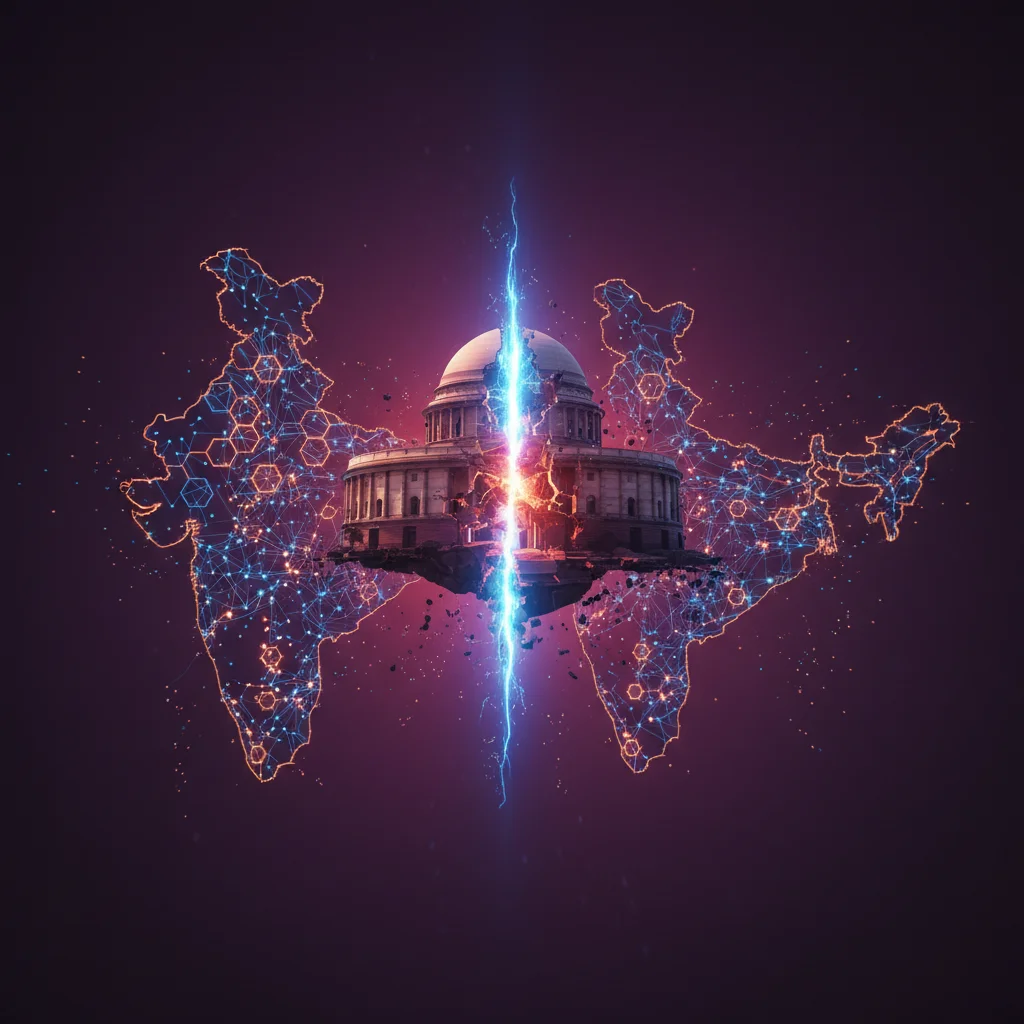
Delimitation Bill 2026: Power Shift or Political Fear?
TL;DR: India's government tried to expand the Lok Sabha from 543 to 850 seats, redraw constituencies using 2011 census data, and activate women's reservation. The constitutional amendment failed on April 17, falling 54 votes short. The defeat exposed a north-south fault line over representation, federalism, and who benefits from counting heads.
What Happened in Parliament
On April 16, 2026, the Modi government introduced three interconnected bills during a special Lok Sabha session: the Constitution (131st Amendment) Bill, the Delimitation Bill, and the Union Territories Laws (Amendment) Bill. Together, they proposed the most significant structural change to Indian democracy since independence.
The next day, April 17, the constitutional amendment was voted down. Of 528 MPs present, 298 voted in favour and 230 voted against. The government needed 352 votes, a two-thirds majority of those present. It fell short by 54.
This was the first time a constitutional amendment brought by the Modi government has been defeated in the Lok Sabha.
Since the Delimitation Bill and the UT Laws Amendment Bill both depended on the constitutional amendment passing, the government subsequently withdrew them. The entire exercise collapsed in 24 hours.
The 50-Year Freeze That Created This Crisis
The story starts in 1976. During the Emergency, the 42nd Constitutional Amendment froze the total number of Lok Sabha seats for each state based on the 1971 census. The reasoning was practical: if parliamentary seats were tied to population, states that ran effective family planning programs would lose MPs, while states with unchecked population growth would gain them. That creates a perverse incentive.
The 84th Amendment in 2001 extended the freeze until the first census published after 2026. The idea was to give states more time to stabilize their populations before the redistribution became unavoidable.
That deadline has arrived. The population gap between states has only widened, and the question politicians have been kicking down the road for decades is now on Parliament's floor.
The Numbers Behind the Fight
India's Lok Sabha has had 543 seats since 1973, fixed for a population of roughly 548 million. India now has over 1.4 billion people. The average constituency population hit 2.2 million in the 2011 census and is projected to reach 2.7 million by 2031.
But population growth since 1971 has been wildly uneven:
| State | Pop Growth (1971-2011) | Current LS Seats | Seats if Redistributed (543 total) |
|---|---|---|---|
| Uttar Pradesh | ~138% | 80 | 89 |
| Bihar | ~131% | 40 | 46 |
| Rajasthan | ~156% | 25 | 30 |
| Tamil Nadu | ~56% | 39 | 32 |
| Kerala | ~47% | 20 | 15 |
| Andhra Pradesh | ~63% | 25 | 21 |
Sources: PRS India, The India Forum
If the current 543 seats were redistributed purely by 2011 population, the five southern states would lose as many as 24 seats. That is nearly one-fifth of their current representation. Kerala alone could lose a third of its Lok Sabha strength. Meanwhile, four Hindi heartland states (UP, Bihar, Rajasthan, and MP) would together gain 34 seats.
Kerala's fertility rate dropped to 1.6 by 2021. Bihar's was still above 3.0. In a strictly population-based system, Kerala gets fewer MPs for being responsible, and Bihar gets rewarded for the opposite. That paradox is the engine driving this entire conflict.
What the Government Actually Proposed
The Constitution (131st Amendment) Bill had four major components:
1. Expand the Lok Sabha from 543 to 850 seats. The new maximum would be 815 seats from states and 35 from union territories, up from the current 530 and 20 respectively.
2. Use the 2011 census for delimitation. Since Census 2027 is ongoing and results won't be ready for years, the government proposed using existing population data. The Delimitation Bill would empower a commission headed by a Supreme Court judge, along with the Chief Election Commissioner and state election commissioners, to redraw every constituency.
3. Activate women's reservation. The 106th Amendment Act of 2023 reserved one-third of Lok Sabha and state assembly seats for women, but implementation was tied to a census and delimitation. The 2026 bill removed the census precondition, linking it only to delimitation.
4. Give Parliament control over delimitation timing. The amendment would allow Parliament to decide by simple majority when to carry out delimitation and which census data to use. Previously, this was constitutionally governed.
Home Minister Amit Shah's sales pitch was straightforward. Under a 50% expansion, he argued, southern states' 129 existing seats would rise to 195. Their share of the total house would remain at roughly 24%. Karnataka's 28 seats (5.15% of the current total) would become 42 (5.14%). Nobody loses seats. Everyone gains.
On paper, the arithmetic works.
In practice, the argument fell apart.
Five Reasons It Failed
1. Relative Power Still Shifts
Even if no state loses seats in absolute terms, the relative weight of regions changes dramatically. When Uttar Pradesh's delegation jumps from 80 to potentially 120+ MPs and Tamil Nadu goes from 39 to maybe 55, the internal dynamics of coalition politics shift fundamentally.
As Mohd. Sanjeer Alam of the Centre for the Study of Developing Societies pointed out, "a Lok Sabha constituency in Rajasthan had 1.5 times the population that it did in Kerala." Population-based redistribution makes that gap official policy. Southern states see this not as representation reform but as a structural transfer of political power to the north.
2. The Fiscal Injustice Argument
Southern states already contribute disproportionately to India's tax revenue while receiving less back. Maharashtra gets Rs 0.08 back for every rupee it contributes to the Union government. Kerala contributes significantly more per capita than Bihar but would get fewer seats per capita than Bihar.
For southern politicians, this is a double blow: pay more, get less voice. Tamil Nadu Chief Minister MK Stalin burned a copy of the bill and raised black flags in protest. MPs from several southern states turned up in Parliament dressed in black. This wasn't theatre. It reflected a genuine perception that demographic trends would permanently tilt political power northward while the south continues bankrolling the Centre.
3. Women's Reservation Was Weaponized
The sharpest criticism targeted the decision to bundle women's reservation with delimitation.
Women represent just 14% of current Lok Sabha members. The 2023 law promised one-third reservation but made it dependent on a census and delimitation first. By tying delimitation to women's reservation in 2026, the government created a political trap: voting against delimitation now meant voting against women's representation.
Congress MP Shashi Tharoor called this out, saying that "to link this to delimitation is to hold the aspirations of Indian women hostage to one of the most complex administrative exercises in India's history."
A standalone women's reservation bill would likely have passed with overwhelming support. Tying it to the most divisive structural reform in decades forced MPs into a false binary. Several opposition leaders accused the government of using women's reservation as a cover for a power grab.
4. Why 2011 Data, Not 2027?
Congress General Secretary K.C. Venugopal questioned why the government insists on using a 15-year-old census when Census 2027 is already underway. CPI(M) MP John Brittas warned that "if delimitation is carried out based on the 2011 census instead of the 1971 census, seats in the northern states will surge dramatically."
The government's counter: waiting for Census 2027 results would delay women's reservation by several more years. But this argument circles back to the bundling problem. If the government had delinked women's reservation from delimitation, there would be no urgency to use outdated data.
5. The Process Was Rushed
The bills were circulated less than 48 hours before parliamentary presentation. Critics called this "trampling of sacrosanct institutions," arguing a constitutional change of this magnitude deserved public consultation, committee examination, and extended parliamentary debate.
More troubling: the amendment would have transferred delimitation timing decisions from the Constitution to Parliament, requiring only a simple majority. This means the ruling party of the day could trigger or delay delimitation at will. As one analysis noted, delinking delimitation from the census and subjecting it to parliamentary will "no longer needs two-thirds majority" for future exercises, weakening the Rajya Sabha's check on such decisions.
The Coalition Arithmetic Behind the Defeat
The vote tally itself tells a story about India's current political landscape. The BJP-led NDA holds roughly 293 seats in the Lok Sabha. For a constitutional amendment, the government needed at least two-thirds of members present and voting: 352 out of 528.
Where did the 54-vote gap come from? Not just the opposition. Several NDA allies, particularly those from southern states, either abstained or voted against. The Telugu Desam Party (TDP), a key BJP coalition partner from Andhra Pradesh, had voiced concerns about the impact on their state's representation. When the chips fell, the government could not hold its own coalition together on this issue.
This is significant. The BJP has governed since 2014 with the ability to push through most legislation. On delimitation, the regional pull was stronger than party discipline. Southern NDA allies calculated that siding with the government on this particular bill would cost them more at home than defying the whip.
The opposition's strategy was straightforward. By framing the bill as a northern power grab, they peeled off enough regional allies to block the supermajority. It worked because the underlying anxiety is real: in a purely population-driven Parliament, the political centre of gravity shifts permanently to the Hindi belt.
What the Media Coverage Missed
The delimitation debate was extensively covered, but several dimensions got far less attention than they deserved.
The Rajya Sabha angle. The Lok Sabha-to-Rajya Sabha ratio would have shifted from 2.2:1 to 3.3:1. This reduces the Upper House's relative influence in presidential and vice-presidential elections, a significant constitutional shift that received almost no media attention.
The cabinet expansion factor. India's Constitution limits the council of ministers to 15% of Lok Sabha strength. At 543 seats, that is about 81 ministers. At 850, it jumps to roughly 122. A bigger cabinet means more ministerial berths to distribute, a powerful patronage tool. This political incentive for expansion was rarely discussed.
The draft vs the promise gap. Amit Shah's 50% uniform increase formula was the government's political commitment. But the actual draft bill did not explicitly guarantee a uniform percentage increase. The allocation was to be left to the Delimitation Commission. This gap between spoken assurance and legal text was underreported.
Pro-government outlets emphasized the women's reservation angle, framing opposition as anti-women. Opposition-aligned media focused heavily on the north-south divide. Both frames were incomplete. The story of delimitation is not just about gender or geography. It is about the structure of power in the world's largest democracy, and the mechanisms by which that structure can be changed.
How Other Democracies Handle This
India isn't the first country to face this problem.
The European Union uses degressive proportionality: larger countries get more European Parliament seats, but not in strict proportion to population. Smaller nations get slightly higher per-capita representation to prevent them from becoming irrelevant.
The United States has a fixed House of Representatives (435 seats since 1929) but balances it with the Senate, where every state gets exactly two seats regardless of population. Wyoming (577,000 people) has the same Senate voice as California (39 million).
India's Rajya Sabha was designed for a similar federal balancing role, but its seats are allocated roughly by state population, not equally. This means India lacks the structural counterweight that the US Senate provides.
Telangana Chief Minister Revanth Reddy proposed a hybrid model: 50% of new seats would be population-proportional, the rest allocated based on factors like economic contribution and development indicators. This mirrors the EU approach and gained traction as a potential compromise.
Experts like Alam have suggested expanding the Lok Sabha without reducing any state's existing seats while simultaneously equalizing Rajya Sabha representation. Give every state equal Upper House seats (like the US Senate), and the federal balance is restored even if the Lower House is purely population-based. Ambitious, but architecturally sound.
What Happens Now?
The defeat of the 131st Amendment shelves delimitation for the foreseeable future. The government's plan to have new constituencies ready for the 2029 general election is now dead.
Several paths forward exist:
Modified reintroduction. A revised bill that explicitly codifies the uniform seat increase (not just promises it), delinks women's reservation from delimitation, or commits to Census 2027 data could attract broader support. The BJP would need its coalition allies, particularly the TDP from Andhra Pradesh, which has its own regional calculations.
Standalone women's reservation. Passing women's reservation without the delimitation baggage would likely command the two-thirds majority. This is arguably what should have happened from the start.
Another freeze. Parliament could extend the delimitation deadline again, as it did in 1976 and 2001. It kicks the problem forward but avoids immediate political damage.
Structural reform. Reforming the Rajya Sabha to give equal representation to all states (the US Senate model) would make population-based Lok Sabha delimitation less threatening to smaller states. This is the hardest path and the most intellectually honest one.
As one political scientist noted, India is "not merely a democracy of individuals, but a Union of states. Representation must reflect both citizens and constituent units." The BJP's coalition dependence on southern partners like TDP may act as a political brake on any hasty future attempt.
The Real Question
The delimitation debate tests something fundamental about Indian democracy: whether the system can adapt to demographic reality without fracturing along regional lines.
States that controlled their populations were told they were doing the right thing. They now face reduced political voice as a reward for their success. States with unchecked population growth have legitimate claims to proportional representation. Both positions are democratically valid. Neither is entirely wrong.
Finding a framework that honors both principles, individual representation and federal balance, will be one of the defining challenges of Indian governance in the coming decade. The April 2026 vote made one thing clear: rushing through a solution without genuine consensus is not going to work.
Meanwhile, the new Parliament building sits ready. It was constructed with a chamber that can accommodate up to 888 Lok Sabha members, designed specifically for the expansion everyone knew was coming. The infrastructure is waiting. The political will, and more importantly the political consensus, is not.
The bills will come back. The demographic math guarantees it. The question is whether India's political class can design a fairer version before the next attempt.
Sources
- PRS India: The Delimitation Bill, 2026
- PRS India: The Constitution (131st Amendment) Bill, 2026
- Business Today: Delimitation Bill 2026 Decoded
- Al Jazeera: India Plans More Seats for Women, Links to Delimitation
- The India Forum: India's Delimitation Dilemma
- The Wire: Questions Surround Bills to Increase LS Strength
- VisionIAS: Constitution (131st Amendment) Bill Defeated
- Outlook India: Women's Reservation and Delimitation Bill Explained
- PIB: Home Minister Amit Shah's Intervention
- Business Standard: Delimitation and Proportionality
- NUS ISAS: Southern States Up in Arms
- The News Minute: Why This Delimitation Is Suspicious
- The Leaflet: Using Women's Reservation as a Cover
- Vajiram & Ravi: Delimitation Controversy
- Deccan Herald: Why Delimitation Was Linked to Women's Reservation