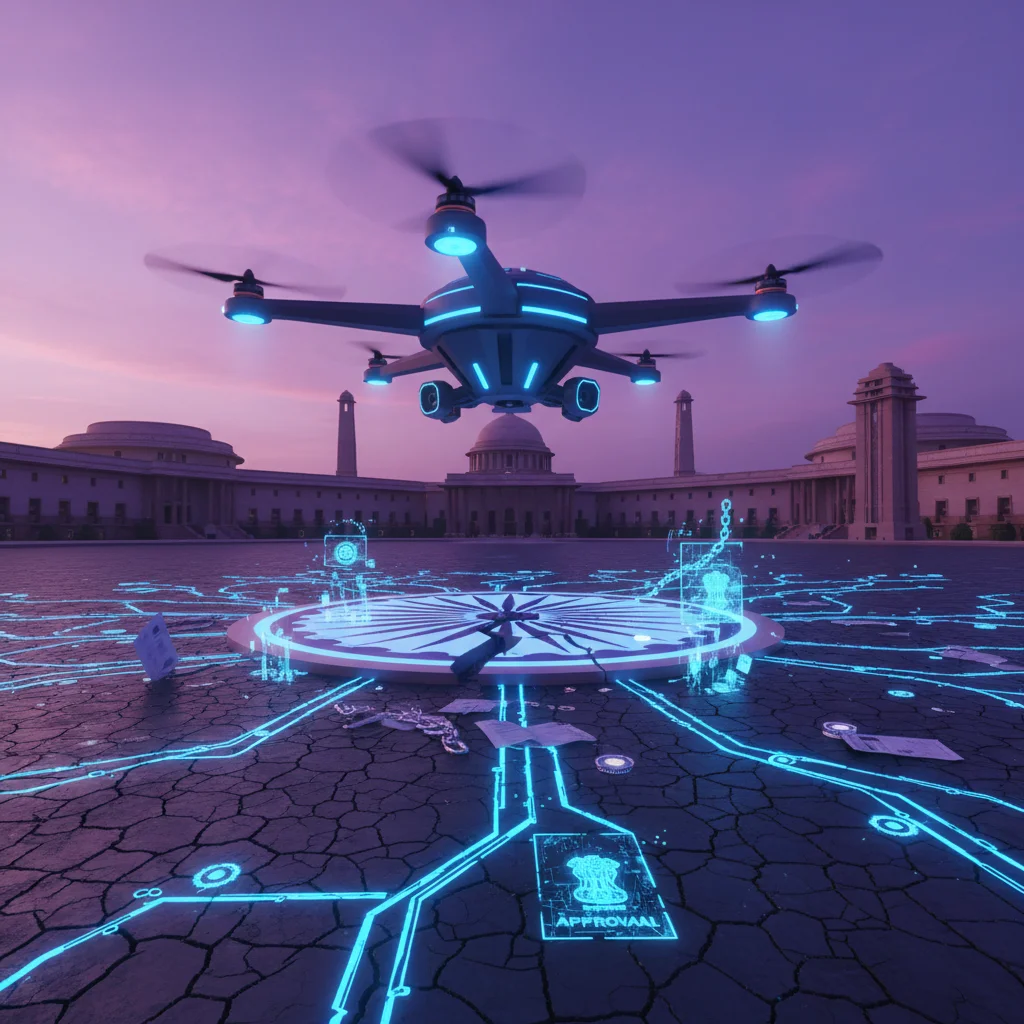
Drone Import Scam: Why This Case Matters Beyond Bribes
TL;DR
The CBI's arrest of a senior DGCA official and a Reliance-linked executive over a Rs 15 lakh drone import bribery scheme is not just another corruption headline. It exposes structural rot in India's aviation regulator at a time when drones are becoming critical national security assets. The real story is not the bribe. It is the system that made the bribe necessary.
What Actually Happened
On April 18, 2026, the Central Bureau of Investigation carried out a trap operation in Delhi that led to two arrests. The accused: Mudavath Devula, a Deputy Director General in the DGCA's Airworthiness Directorate, and Bharat Mathur, a Senior Vice President at Asteria Aerospace Ltd, a drone technology company that is a subsidiary of Jio Platforms under Reliance Industries.
The allegation is straightforward. Three applications for drone import approvals were pending with the DGCA. According to the CBI's FIR, "It was settled among them that Rs five lakh per file has to be delivered as a bribe for processing the file for approval." That is Rs 15 lakh for three files. The CBI caught them during the alleged handover of Rs 2.5 lakh near the IIT Delhi flyover.
Follow-up raids at four locations in Delhi uncovered Rs 37 lakh in cash, along with gold coins, silver coins, and digital devices. Both accused have been booked under the Prevention of Corruption Act and the Bharatiya Nyaya Sanhita, 2023. Asteria Aerospace Ltd itself is named in the FIR under the clause for "bribing a public servant by commercial organisation."
The CBI has indicated that the digital trail may reveal a wider pattern.
Who Is Asteria Aerospace?
Asteria Aerospace is not some fly-by-night operator. Founded in 2011 by Neel Mehta and Nihar Vartak, both aerospace engineers trained at Purdue University, the Bengaluru-based company builds drones for surveillance, inspection, and mapping. Their client list includes defence agencies, government bodies, and private sector firms.
In December 2019, Reliance Industries acquired a 51.78% stake in Asteria through its subsidiary, Reliance Strategic Business Ventures Limited, for Rs 23.12 crore. The plan was to increase that to 87.3% after milestone-based investments of up to Rs 125 crore. Today, Asteria sits under Jio Platforms, the technology arm of Reliance led by Mukesh Ambani.
For the fiscal year 2024-25, Asteria reported revenues of Rs 79 crore, a 90% jump from the previous year. The company posted a net loss of Rs 6.7 crore, with cost of goods sold more than doubling to Rs 49.5 crore. This is a scaling business in a growing sector, not a fringe player.
It is worth noting: the parent company Reliance is not named as an accused in the FIR. The CBI identified Reliance as the "ultimate parent company" based on Asteria's financial statements, but the legal case is directed at Mathur, Devula, and Asteria Aerospace specifically.
The Real Problem: How India Regulates Drone Imports
Here is where most media coverage stops. Arrests happened, money was seized, case filed. But the more important question is: why did a company backed by India's largest conglomerate allegedly need to pay Rs 5 lakh per file to get its import applications processed?
India's Drone Import Policy: Prohibited by Default
India's drone regulations have gone through a dramatic transformation since 2021. The Drone Rules of 2021 simplified compliance significantly, cutting required forms from 25 to five and fee types from 72 to four. The government wanted India to become a "global drone hub by 2030."
But here is the catch. While the rules were simplified for domestic manufacturing and operations, the import policy went the other direction. The Directorate General of Foreign Trade (DGFT) shifted drone imports from "Restricted" to "Prohibited" for most categories. Exceptions exist for government entities, recognised educational institutions, R&D organisations, and defence purposes. Drone component imports, by contrast, were liberalised and made "Free" to encourage local manufacturing under Make in India.
So if you are an Indian company that needs to import complete drone systems for R&D, testing, or integration, you face a maze of approvals. You need import authorisation from the DGFT (in consultation with line ministries), DGCA airworthiness clearances, and potentially WPC (Wireless Planning & Coordination) approvals. Each of these involves different agencies, different timelines, and different officers.
This is the gap where corruption thrives. When approvals are discretionary, slow, and opaque, the incentive to pay for speed is enormous. The Rs 5-lakh-per-file allegedly demanded here is not just a bribe. It is the price of bureaucratic dysfunction in a system handling technologies critical to national security.
The Type Certificate Bottleneck
One of the specific chokepoints is the Type Certificate (TC) requirement. Every drone intended for operation in India needs a DGCA-issued Type Certificate, which certifies its design and safety. The process involves applying on the Digital Sky platform, submitting a prototype for testing by an accredited body like the Quality Council of India, and then waiting.
That waiting is where the rot sets in. When the regulator is understaffed and overwhelmed, pending applications pile up. Officers with signing authority over these files become gatekeepers with extraordinary power. And when oversight is weak, that power becomes monetisable.
The DGCA Staffing Crisis
The drone bribery case does not exist in a vacuum. It sits atop a well-documented institutional crisis at the DGCA that has been building for years.
A parliamentary report tabled in August 2025 called the situation an "existential threat" to India's aviation safety system. The numbers are damning: out of 1,063 sanctioned DGCA posts, only 553 were filled. That is a vacancy rate close to 48%.
Let that sink in. Nearly half the positions at India's aviation safety regulator are empty.
The problem is not new. The parliamentary committee identified an "outdated recruitment model" where a recruitment agency hires on the DGCA's behalf, a process the civil aviation ministry itself described as "slow and inflexible." The regulator bleeds qualified inspectors and technical experts every year but cannot replace them. Mandatory safety audits and certifications pile up in backlogs.
This report came less than two months after the Air India 171 crash in Ahmedabad in June 2025, which killed 260 people. That disaster intensified scrutiny on the DGCA's capacity. The committee's recommendation? A possible new regulatory authority to replace the DGCA entirely. That proposal has gone nowhere so far.
Civil aviation minister Ram Mohan Naidu promised to fill 190 of the 500+ vacant positions by October 2025. Even if that happened on schedule, over 300 positions would remain empty. The committee called this gap "too large for a sector adding aircraft and routes at speed."
In early 2026, the government appointed Vir Vikram Yadav as the new DGCA chief, replacing Faiz Ahmed Kidwai. But a leadership change at the top cannot compensate for empty desks throughout the organisation.
When you have fewer people handling more work in a regulatory body that controls billions of rupees worth of approvals, corruption is not surprising. It is predictable.
Why Drones Are a National Security Concern
The media coverage of this case has largely followed a familiar template: arrests made, money seized, investigation underway. What gets glossed over is why corruption in drone import approvals carries specific national security risks that go beyond standard bribery cases.
The Scale of India's Drone Ambitions
India's drone market was valued at approximately Rs 5,428 crore in 2024 and is projected to reach Rs 11,927 crore by 2029. The defence segment alone is expected to grow at a CAGR of 26.4%. As of January 2025, India had 29,501 registered drones, with Delhi leading at 4,882 registrations.
The government has staked enormous political capital on drones. The Production-Linked Incentive (PLI) scheme launched in September 2021 allocated Rs 120 crore for drone and drone component manufacturers, with PLI 2.0 reportedly expanding to over Rs 1,000 crore. Programmes like Drone Didi aim to deploy 15,000 drones for agricultural use by women's self-help groups. The military drone market alone hit USD 1.95 billion in 2025.
When Import Approvals Become Security Chokepoints
Drones are not regular consumer electronics. They carry cameras, sensors, and in some configurations, payloads. They operate in controlled airspace. Many drone systems, especially those used for surveillance and defence, incorporate technologies subject to export controls in their countries of origin. The DGCA's airworthiness approval is supposed to verify that imported drones meet safety and security standards before they enter the country.
When that approval process is compromised by corruption, you do not just have a bribery problem. You have a potential security gap. If approvals can be bought, what is the quality of the scrutiny being applied? Are specifications being verified? Are end-use certificates being checked? When an officer is taking money to "process files," the incentive is to rubber-stamp, not to examine.
India still imports a significant portion of its drone components. 39% of flight controllers come from China (90% for small drones), and rare earth magnets essential for drone motors are 100% imported with no domestic alternatives yet. The supply chain has vulnerabilities. Regulatory integrity is supposed to be the backstop. If that backstop is for sale, the entire system has a single point of failure.
How Media Framed This Story
As a media analysis platform, we pay attention to how stories are told, not just what they contain. The coverage of this drone bribery case follows some predictable patterns worth noting.
Pattern 1: Arrest-First, System-Later
The overwhelming majority of headlines focused on the arrests. "CBI arrests DGCA official," "Senior executive of major corporate group arrested," "Rs 37 lakh seized." These are dramatic details that generate clicks. And almost every outlet led with them.
What got buried: the systemic conditions that enabled the bribery. The staffing crisis at DGCA, the import approval bottleneck, the gap between India's drone ambitions and its regulatory capacity. These require more reporting effort and yield fewer clicks.
Pattern 2: The Reliance Question
International outlets like Free Malaysia Today explicitly named Reliance in their headlines. Indian outlets were more cautious, referring to "senior executive of major corporate group" without naming Reliance directly in most headlines, though several mentioned Asteria's connection in the body text.
This is not unusual. Large corporate names carry legal risk for publishers. But the result is that readers of headlines alone may not grasp the scale of corporate involvement. The FIR does not name Reliance as an accused, and that distinction matters legally. But the connection through Jio Platforms and RSBVL is a matter of public record.
Pattern 3: Missing the Bigger Picture
Very few outlets connected this case to the broader DGCA crisis or to India's drone policy architecture. The parliamentary report on DGCA staffing, the import policy contradictions, the Type Certificate bottleneck: these threads were largely absent from breaking news coverage. The Week provided one of the more detailed explainers, but even that focused primarily on the case mechanics rather than the institutional environment.
This is a recurring pattern in Indian media: the event gets covered, the system that produced it does not. Readers learn that someone was arrested but not why the system enabled the arrest in the first place. At The Balanced News, we have explored similar patterns in how ED raids are covered by media, where language choices signal guilt before any court verdict.
The Corruption That Headlines Miss
India ranked 91st on Transparency International's Corruption Perceptions Index in 2025, down from 76th a decade ago. That slide is not abstract. It shows up in specific cases like this one.
The Rs 5-lakh-per-file rate is almost comically low for what is at stake. Asteria Aerospace reported Rs 79 crore in revenue last year. The total alleged bribe was Rs 15 lakh. That is 0.019% of annual revenue. For that amount, you allegedly get three import applications fast-tracked through a regulator that controls access to a market worth thousands of crores.
This suggests the going rate is established and normalised. It is not a one-off demand from a rogue officer. The CBI has hinted at this, noting that "evidence gathered indicates a larger financial arrangement tied to multiple regulatory clearances." If that trail leads further, this case could reveal a systemic pricing mechanism for regulatory access.
And this is the part that should worry anyone who cares about India's industrial ambitions. The government wants India to be a global drone hub by 2030. It has created PLI schemes, simplified regulations, and built digital platforms. But if the officials who sit between policy intent and ground-level implementation are extracting rents at every stage, the entire ecosystem is compromised.
The policy architecture says "Make in India." The bureaucratic reality says "Pay in India." That gap is the real scandal.
What Happens Next
The CBI investigation is ongoing. Digital devices seized from the raids are being analysed for financial trails and communication records. The agency is reportedly examining whether this was an isolated arrangement or part of a recurring pattern across multiple drone companies.
If the investigation widens, it could trigger a broader audit of DGCA approval processes, not just for drones but for the aviation sector as a whole. The parliamentary committee's recommendation to create a new regulatory authority may gain fresh momentum.
For the drone industry specifically, this case could have a chilling effect. Companies navigating legitimate import processes may face even longer delays as the DGCA becomes defensive and risk-averse. The irony would be that a corruption case intended to clean up the system makes the system slower for honest players.
On the corporate side, Reliance has not been charged. But the association with a bribery case involving its subsidiary's employee and applications will invite scrutiny of governance standards across the Reliance ecosystem's regulatory interactions.
The Takeaway
This case is not about Rs 15 lakh. It is about a regulator that cannot keep up with the sector it regulates. A drone policy that simultaneously promotes manufacturing and restricts imports through a broken approval system. A staffing crisis so severe that nearly half the DGCA's positions are empty. And a media ecosystem that covers the arrest but misses the architecture.
The CBI did its job. The question is whether anyone will do the harder job of fixing the system that made this arrest inevitable.
Sources
- The Week: Why CBI arrested senior DGCA official in bribery case EXPLAINED
- The Print: CBI arrests DGCA official in drone import bribery case
- The Tribune: CBI arrests deputy DGCA and corporate executive
- ANI: CBI arrests DGCA Deputy Director General
- Moneylife: CBI nabs DGCA official, Rs 37 lakh seized
- Free Malaysia Today: India arrests Reliance officials in drone bribery probe
- Business Standard: DGCA staffing crisis a threat to aviation safety
- Travel and Tour World: India's DGCA faces critical staffing shortage
- YourStory: RIL arm acquires 51.78% stake in Asteria Aerospace
- India Briefing: Investing in India's drone industry
- PIB: PLI Scheme for Drones
- InsideFPV: Indian Drone Market 2025