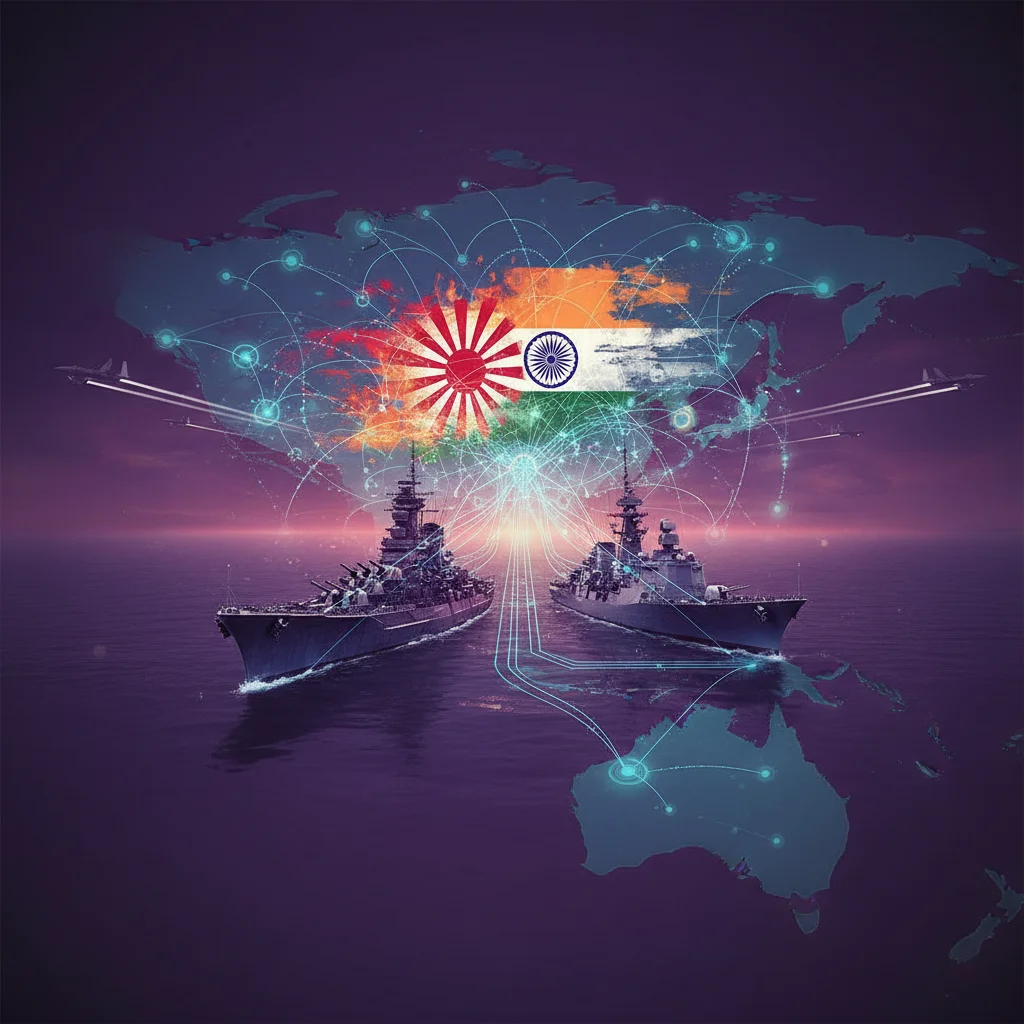
Japan's Arms Export Shift: Why India Should Care
TL;DR
Japan just scrapped its decades-old ban on lethal weapons exports, the biggest shake-up to its pacifist defence posture since World War II. For India, this isn't a distant headline. It opens the door to advanced naval technology, deepens a strategic partnership already producing results like the UNICORN radar project, and reshapes the military balance across the Indo-Pacific at a time when both nations share a common concern: China.
The Day Japan Rewrote Its Defence Playbook
On April 21, 2026, Prime Minister Sanae Takaichi's cabinet did something that would have been unthinkable a generation ago. It approved revisions to the "Three Principles on Transfer of Defence Equipment and Technology," effectively removing the last major restrictions on what Japan can sell to the world.
Fighter jets. Missiles. Destroyers. All now on the table.
Until this week, Japanese arms exports were limited to five narrow categories: rescue, transport, alert, surveillance, and minesweeping equipment. That framework, born from a pacifist constitution written in the ashes of Hiroshima and Nagasaki, survived the Cold War, the War on Terror, and every geopolitical tremor in between.
Not anymore.
"No single country can now protect its own peace and security alone," Takaichi said, defending the shift. "It is essential that partner countries support each other with defence equipment in an increasingly severe security environment."
The new framework classifies defence equipment into two buckets: "weapons" (lethal systems like warships, tanks, and missiles) and "non-weapons" (radars, protective gear, and similar). Exports of lethal systems now require approval from Japan's National Security Council and are initially limited to 17 countries with existing defence agreements. Sales to countries in active conflict remain restricted, though "special circumstances" exceptions exist for national security.
How Japan Got Here: A 60-Year Unravelling
This didn't happen overnight. Japan's journey from total arms export ban to global defence market player has been a slow, deliberate erosion of pacifist constraints, each step driven by a new security threat.
| Year | What Changed |
|---|---|
| 1967 | Three Principles on Arms Exports adopted. Ban on exports to communist states, UN-embargoed nations, and conflict zones |
| 1976 | PM Takeo Miki expanded restrictions to a near-total ban on all arms transfers |
| 1983 | First exception: arms technology licensing to the United States |
| 2014 | PM Shinzo Abe replaced the old ban with new "Three Principles" allowing conditional exports |
| 2023 | PM Fumio Kishida revised guidelines to allow export of finished lethal weapons, including Patriot missiles |
| 2026 | PM Takaichi's cabinet removes remaining category restrictions entirely |
Each revision reflected a specific trigger. In 2014, it was China's assertiveness in the East China Sea. In 2023, the wars in Ukraine and the Middle East strained American weapons production and made allied nations anxious about supply diversification. In 2026, the trigger is compounding: a less reliable American security umbrella under Trump's second term, persistent North Korean provocations, and China's continued military build-up.
Japan has also steadily increased its defence spending to 2% of GDP. Defence is now one of 17 strategic growth sectors under the Takaichi government.
The Australia Deal That Changed Everything
Three days before the export ban was lifted, Japan and Australia signed what amounts to a proof of concept for Japan's new defence ambitions.
On April 18, 2026, the two countries finalised a deal for Mitsubishi Heavy Industries (MHI) to build 11 upgraded Mogami-class frigates for the Royal Australian Navy. Three will be built in Japan and delivered starting 2029; eight more will be jointly produced. The price tag? Up to AU$20 billion (roughly US$14.3 billion) over the next decade.
These aren't minor patrol boats. The 466-foot Mogami-class ships carry a 32-cell vertical launch system, have a range of 10,000 nautical miles, and can operate an MH-60R Seahawk helicopter. A decisive factor in Australia choosing them: they require just 90 crew members, about half of what current Australian frigates need.
Japanese Defence Minister Shinjiro Koizumi and Australian counterpart Richard Marles signed the "Mogami Memorandum" aboard the frigate JS Kumano, docked off Melbourne. MHI's share price jumped nearly 4% on the news, capping a 75% rise over the past 12 months.
The timing wasn't accidental. Signing the deal days before lifting the export ban created a powerful signal: Japan isn't just talking about becoming a defence exporter. It already is one.
And the pipeline is growing. The Philippines is exploring the purchase of used destroyers. New Zealand is eyeing its own version of the Mogami-class. Indonesia, Poland, and several other nations are in talks. Japan has also sent 1,400 combat troops to the Philippines for the Balikatan exercise, the largest Japanese military deployment abroad since World War II.
Why India Should Pay Attention
India doesn't appear on the initial list of buyers making headlines. But the India-Japan defence corridor is arguably more significant than any single arms deal, because it's built on something harder to acquire than hardware: technology transfer and co-development.
The UNICORN Project
In November 2024, India and Japan signed a Memorandum of Implementation for the co-development of the Unified Complex Radio Antenna (UNICORN) mast for Indian Navy ships. It marked Japan's first-ever export of cutting-edge defence technology to India.
UNICORN, also known as Nora-50, integrates multiple communication systems and antennas into a single compact structure. The result: reduced radar cross-section, improved stealth, and optimised high-speed communication across multiple frequencies. The technology was originally developed for Japan's own Mogami-class frigates, the same ones Australia just ordered.
Here's what makes this different from a standard arms purchase: India isn't just buying the product. Bharat Electronics Limited (BEL) will co-produce it domestically, with design and engineering support from Yokohama Rubber, NEC Corporation, and Sampa Kogyo KK. Defence Minister Rajnath Singh inspected a UNICORN-equipped vessel, the JS Kumano, during a visit to Yokosuka naval base in 2024.
This is the "Make in India" vision actually working in defence. And Japan's new export framework dramatically expands what's possible next.
Institutional Depth
The numbers tell a story of deepening ties:
- Annual prime ministerial summits since 2006
- Regular "2+2" foreign and defence ministerial dialogues (the third round was held in August 2024)
- Joint naval exercises, including the Malabar series with the US and Australia
- Signed agreements on sharing sensitive military intelligence and defence technologies
- Joint development of unmanned ground vehicles under discussion
India has a strategic incentive Japan understands well. Having lost territory to China in the 1962 border war (an area equivalent in size to Japan's Kyushu island), India remains committed to building indigenous defence capability rather than relying on alliance guarantees. Japan's willingness to transfer technology, not just sell finished products, aligns perfectly with this.
Japan also has direct economic stakes in Indian stability. Its companies have major supply-chain interests in India's North Eastern Region, including involvement in semiconductor facilities under construction in Assam. Escalation with China would carry direct consequences for Japan's economic security too.
What Could Come Next
With the export ban lifted, the ceiling on India-Japan defence cooperation has been raised. Areas where deeper collaboration is now possible include:
- Submarine technology: Japan's Soryu and Taigei-class submarines are among the most advanced conventional subs in the world
- Next-generation fighter jets: Japan is co-developing the Global Combat Air Programme (GCAP) with the UK and Italy
- Advanced missile systems: Type-12 surface-to-ship missiles, recently deployed in Kyushu, have extended range into contested East China Sea waters
- Maritime surveillance: Drones and patrol aircraft for Indian Ocean monitoring
- Ship maintenance: Indian shipyards are being positioned as MRO hubs for Japanese naval vessels
The bilateral bureaucratic challenges that have historically slowed India-Japan defence deals haven't disappeared. But the policy barrier on Japan's side is now lower than it has ever been.
Not Everyone Is Celebrating
Domestic Opposition in Japan
If you only read international coverage, you'd think Japan's pivot was universally welcomed. It wasn't.
On April 19, roughly 36,000 people gathered near the National Diet Building in Tokyo to protest constitutional revision and the arms export expansion. It was the second rally in two weeks to draw over 30,000 people. Earlier protests on April 5 in Ikebukuro drew 6,000 more. Placards read "Protect Article 9," "No War," and "Takaichi Government Step Down Now."
Japanese Communist Party member Taku Yamazoe called the move a path toward making Japan a "war-profiteering nation." Centrist Reform Alliance secretary-general Takeshi Shina warned that allowing the cabinet to push "unrestricted arms exports at its own discretion, without parliamentary involvement, could erode Japan's pacifist foundation."
The protests reflect a genuine divide in Japanese society. For many citizens, Article 9 isn't an outdated relic. It's a moral commitment born from the devastation Japan inflicted across Asia during World War II and the atomic bombings that ended it. One protester told The Washington Post: Japan inflicted "profound suffering across Asia during wartime," and its pacifist constitution was drafted "in reflection on that history."
There's also a procedural critique worth noting. These changes were made by cabinet decision, not through parliamentary legislation. Opposition parties argue this bypasses democratic oversight on a matter of constitutional significance.
China's Response
Beijing's reaction was swift and pointed. Chinese Foreign Ministry spokesperson Guo Jiakun warned that the international community will "firmly resist Japan's reckless new-style militarisation." Earlier in April, spokesperson Mao Ning had accused Tokyo of pursuing an "offensive, expansionist and dangerous defence policy" that contravenes the Cairo Declaration and the Potsdam Proclamation.
China's objections aren't purely rhetorical. A Japan that exports advanced frigates to Australia and stealth technology to India is a Japan that multiplies the deterrent capacity of the entire Indo-Pacific partner network. From Beijing's perspective, every Mogami-class frigate sold is a node in an expanding web of containment.
How Indian Media Covered It (and What It Missed)
Indian defence publications like Bharat Shakti and IDRW were quick to cover the story, framing it primarily through a strategic lens: what this means for the Indo-Pacific balance and India's own defence modernisation.
The Print provided detailed context on the policy evolution and connected it to Japan's record military deployment to the Philippines. These outlets did a solid job explaining the "what" and the "so what."
What's largely missing from Indian coverage, though, is the domestic Japanese angle. The 36,000-strong protests, the constitutional debate, the parliamentary bypass questions barely registered in Indian reporting. This matters because the sustainability of Japan's arms export push depends significantly on domestic political support. If a future Japanese government faces a pacifist backlash strong enough to scale back exports, partner nations building procurement plans around Japanese equipment could find themselves exposed.
It's also worth noting that Indian media tends to frame Japan's shift almost entirely as "good for India." The more nuanced reality is that it's good for India's strategic options, but it also accelerates an arms build-up dynamic across Asia that India will need to navigate carefully, especially in its own relationships with China and Russia.
The Bigger Picture
Japan's arms export shift isn't happening in isolation. It's part of a broader restructuring of the global defence order, one that touches every major relationship in the region.
The Fading American Umbrella
The United States, historically the world's dominant arms supplier and Asia's primary security guarantor, is increasingly seen as an unreliable partner. The wars in Ukraine and the Middle East have strained American weapons production capacity. President Trump's second term has deepened allied anxieties about Washington's commitment to collective security. When the US can't deliver enough ammunition to Ukraine or munitions to Taiwan on schedule, the question stops being theoretical: what happens when your primary security guarantor is overextended?
Japan's answer is to become more self-reliant and to build its own web of defence partnerships. So is South Korea, which has rapidly expanded its defence exports to Poland and elsewhere. So is India, through BrahMos sales to the Philippines and Vietnam. The era of American monopoly on Pacific security is ending, replaced by a messier, more multipolar system where middle powers arm each other.
The Russia Complication for India
There's a dimension here that Indian strategic planners can't ignore: Russia. India has historically been one of the world's largest importers of Russian military equipment. That relationship has come under strain since 2022. Western sanctions, the diversion of Russian production capacity to the war in Ukraine, and growing concerns about the reliability of Russian supply chains have all created procurement headaches for New Delhi.
Japan's opening offers India a credible alternative for specific capability gaps, particularly in naval technology, submarine systems, and maritime surveillance. Diversifying away from Russian dependence isn't just a Western talking point anymore. It's a practical necessity driven by delivery delays, spare parts shortages, and the reputational cost of maintaining a deep defence relationship with a country under international sanctions.
But this also creates diplomatic tension. New Delhi has worked hard to maintain strategic autonomy, balancing relationships with Moscow, Washington, and Tokyo simultaneously. Deepening the Japan defence corridor inevitably shifts the balance in ways that Russia (and China) will notice.
Opportunity Meets Complexity
For India, Japan's shift represents both an opportunity and a complexity. The opportunity is clear: access to some of the world's most advanced conventional military technology, built by a country that wants to sell it and has strategic reasons to make India stronger. The complexity is that every new arms flow into the region invites counter-moves. China's military budget already dwarfs Japan's and India's combined. An arms race nobody can afford doesn't serve anyone's security.
The smart play for New Delhi is to deepen the technology-transfer dimension of the relationship, as the UNICORN project demonstrates, rather than chase headline arms deals. Building indigenous capability with Japanese engineering support creates lasting strategic value in a way that off-the-shelf purchases never can. The UNICORN model, where Indian companies like BEL absorb Japanese engineering and produce domestically, should be the template for every future collaboration.
Key Takeaways
- Japan has removed the last major restrictions on lethal weapons exports, the most significant change to its defence posture since 1945
- The $14.3 billion Australia-Japan frigate deal signals the beginning of Japan as a serious global defence exporter
- India-Japan defence cooperation, already producing results through the UNICORN stealth radar project, now has a dramatically higher ceiling
- The shift faces genuine domestic opposition in Japan, with tens of thousands protesting and opposition parties questioning the process
- For India, the strategic opportunity lies less in buying Japanese weapons and more in co-developing advanced defence technology
- The broader trend is a multipolar defence order in the Indo-Pacific, with middle powers increasingly arming each other as American reliability wanes
Sources
- Al Jazeera: Japan lifts ban on lethal weapons exports
- NPR: Japan approves scrapping a ban on lethal weapons exports
- CNBC: Japan scraps ban on lethal weapons exports
- CNN: Japan opens door to global arms market
- Japan Times: Japan scraps limits on lethal arms exports
- Stars and Stripes: Australia, Japan strike frigate deal
- CNBC: MHI shares jump on warship deal
- Bharat Shakti: Japan opens door to arms exports
- The Print: Japan overhauls pacifist military approach
- Army Recognition: Japan-India UNICORN technology transfer
- The Defense Post: Japan to export UNICORN antenna to India
- ORF: India-Japan UNICORN partnership
- ISSF: Japan's defence transformation implications
- VIF: Japan's arms export double-edged sword
- Hudson Institute: Japan-India strategic evolution
- Washington Post: Japan pacifist protests
- Xinhua: 30,000 protesters rally in Tokyo